Why You Keep Starting New Things (and Never Finishing Them)

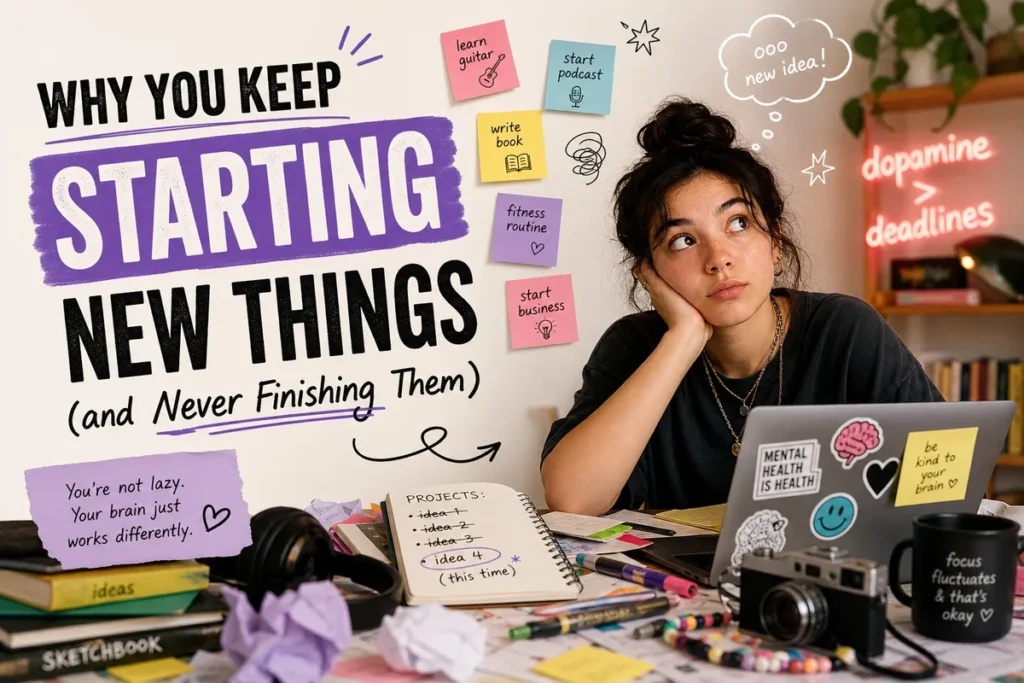
You have a guitar in your closet that you played obsessively for three weeks. A Duolingo streak that hit 47 days before vanishing. A crochet kit under your bed with one lumpy square completed. Roller skates you wore twice. A journal with four entries, all from the same week in March. And right now, you're probably researching your next thing, the one that will finally be different, the one you'll actually stick with this time.
You won't. And that's not a moral failure. That's your brain doing exactly what it was built to do.
If you've ever wondered why your ADHD new hobby obsession burns so bright and dies so fast, you're about to understand exactly what's happening inside your skull. More importantly, you're going to learn how to stop fighting it and start working with it.
The Neuroscience Behind Your Abandoned Hobbies
Your brain runs on dopamine. Not in the oversimplified "happy chemical" way that wellness influencers describe, but in a much more specific way: dopamine is the neurotransmitter of anticipation and motivation. It's what makes you want to do things. Not enjoy them, necessarily. Want them.
In neurotypical brains, dopamine flows relatively steadily. Tasks that need to get done still get a baseline level of motivational juice, even when they're boring. In ADHD brains, that baseline is lower. Way lower. Your brain has fewer dopamine receptors and releases dopamine differently, which means everyday tasks feel like trying to start a car with a dead battery.1
But here's where your ADHD new hobby pattern makes perfect neurological sense: novelty is one of the most powerful dopamine triggers that exists. When you discover something new, your brain floods with anticipation. The possibility space feels infinite. You don't know your limits yet, so everything seems achievable. Your brain, starving for dopamine, latches onto that flood like someone finding water in a desert.
Your brain isn't chasing hobbies. It's chasing the dopamine that new things produce. The hobby is just the delivery mechanism.
This is why the first few weeks of anything feel electric. You're not just learning guitar; you're mainlining neurochemical reward every time you master a new chord. The dopamine isn't coming from the activity itself. It's coming from the novelty of the activity. And novelty, by definition, has an expiration date.
Why ADHD Interest Fades (It's Not About Willpower)
Around week three or four, something shifts. The basic skills start to solidify. The learning curve flattens. You know what the hobby involves now, and the infinite possibility space collapses into a much more defined reality. Suddenly, guitar isn't "anything could happen." It's "I need to practice scales for six months before I can play the songs I actually want to play."
Your brain, the opportunistic dopamine hunter that it is, notices that the novelty well has run dry. The same activity that produced massive neurochemical reward three weeks ago now produces almost nothing. Not because you're lazy. Not because you don't care. Because the novelty is gone, and novelty was the point.
This is when ADHD novelty seeking kicks into high gear. Your brain starts scanning for the next new thing, the next untapped dopamine source. Maybe you start researching pottery. Or mushroom foraging. Or building a capsule wardrobe. The specific interest doesn't matter. What matters is that it's new, which means it's full of that sweet anticipatory dopamine your brain is desperate for.
The Novelty Timeline: For most ADHD brains, the intense honeymoon phase lasts two to six weeks. After that, you're running on fumes unless you find ways to re-inject novelty into the activity.
Here's what neurotypical people don't understand: when they lose interest in something, they can usually push through on discipline alone. Their baseline dopamine is high enough that "just do it" actually works. When your ADHD interest fades, you're not just unmotivated. You're neurochemically incapable of generating the motivation you need. Telling yourself to try harder is like telling yourself to raise your blood pressure through willpower. The mechanism doesn't work that way.
The Graveyard of Good Intentions
Let's talk about the shame for a second, because you're carrying a lot of it.
Every abandoned hobby feels like evidence of your fundamental brokenness. You've internalized the message that follow-through is a character trait, and your inability to finish things means you lack character. You look at the guitar in the closet and you don't see a dopamine-seeking pattern playing out exactly as neuroscience predicts. You see proof that you can't commit to anything.
You've probably heard some version of this from people in your life. "You never stick with anything." "This is just like the time you quit piano." "Why do you always have to start something new?" These comments land like verdicts. Like your ADHD new hobby cycle is a moral indictment rather than a neurological pattern.
But think about it this way: if someone had a vision problem that made reading difficult, would you call them lazy for not finishing books? Your brain has a dopamine regulation problem that makes sustained interest difficult. That's not a character flaw. That's a description of how your brain works.
The shame isn't protecting you from anything. It's not making you more likely to finish things. It's just making you feel terrible about a pattern you didn't choose and can't willpower your way out of.
The hobbies in your closet aren't failures. They're evidence that you have an active, curious brain that gets genuinely excited about learning new things. The fact that the excitement doesn't last isn't a personality defect. It's a neurochemical reality that you can learn to work around.
Why "Just Pick One Thing and Stick With It" Doesn't Work
If you've ever tried to force yourself to continue a hobby after the novelty wore off, you know how brutal it is. You sit down with the guitar and every fiber of your being screams that you should be doing something, anything, else. You might manage a few half-hearted practice sessions. Maybe you guilt yourself into a week of effort. But the dopamine isn't there, and without dopamine, motivation isn't there, and without motivation, you're trying to run a marathon with no legs.
The advice to "just pick one thing" assumes that all brains work the same way. It assumes that discipline is a universal resource that everyone can access equally. For ADHD brains, discipline is dependent on dopamine, and dopamine is dependent on factors you can't directly control.
This doesn't mean you're doomed to forever bounce between interests. It means the standard advice won't work for you. You need strategies designed for a brain that operates on different rules.
Working With Your ADHD Novelty Seeking Brain
Here's the reframe that changed everything for me: instead of trying to eliminate your need for novelty, learn to inject novelty into existing interests.
The guitar doesn't have to stay boring. You could learn a completely different genre than you started with. You could start making TikToks about your progress. You could find a practice buddy and introduce a social element. You could buy a loop pedal and change the entire nature of what guitar means to you. Each of these changes introduces new neural pathways, new challenges, new dopamine opportunities.
The key insight is that novelty isn't just about new activities. It's about new neural engagement. Anything that makes your brain process an activity differently can trigger that novelty response. Same guitar, new context, new dopamine.
Novelty Injection Strategies: Change your environment (practice in a park instead of your room). Change your goal (learn a song in a language you don't speak). Change your community (join a Discord about it). Change your output (document it publicly). Any change that makes your brain re-engage counts.
Another approach: embrace the rotation. Instead of trying to maintain one hobby continuously, keep three or four in active rotation. When your ADHD interest fades in one, you haven't failed. You've just reached the natural point where you rotate to the next one. By the time you cycle back around, enough time has passed that the first hobby feels somewhat novel again.
This requires letting go of the neurotypical ideal of linear progress. Your path will look more like a spiral, touching the same points multiple times but always from a slightly different angle. That's not worse than linear. It's just different.
The Hidden Advantage of Your ADHD New Hobby Pattern
Here's something the shame narrative never mentions: your pattern gives you something most people don't have.
You have surface-level knowledge in fifteen different domains. You know a little about guitar, a little about crochet, a little about coding, a little about fermentation, a little about whatever else you've picked up and put down. This breadth might feel useless compared to someone who spent ten years mastering one thing. But breadth is its own form of valuable.
Some of the most innovative work happens at the intersection of fields. The person who knows a little about music and a little about programming creates something neither specialist would have imagined. Your diverse hobby graveyard isn't a collection of failures. It's a unique combination of knowledge that no one else has in quite the same configuration.
Research on creativity consistently shows that broad exposure to different domains produces more novel ideas than deep expertise in one domain.2 Your brain's ADHD novelty seeking has, without you realizing it, been building creative infrastructure this whole time.
You're not a failed specialist. You're an accidental polymath. The world needs both.
This isn't toxic positivity or cope. It's a genuine reframe based on how creativity and innovation actually work. The skills you picked up in three weeks of obsessive interest don't disappear when you move on. They're in there, waiting to connect with something else.
Practical Systems for a Novelty-Seeking Brain
Let's get concrete about how to manage your ADHD new hobby pattern without fighting your brain's basic wiring.
First, budget for hobby acquisition like you budget for money. You know you're going to pick up new interests. Instead of pretending you won't, plan for it. Set a rule: you can only start one new hobby per month, or you can only buy supplies for a new hobby after a two-week waiting period. This isn't about stopping the pattern. It's about making sure the pattern doesn't bankrupt you or fill your entire house with equipment.
Second, create an "interest parking lot." When the urge to start something new hits, write it down somewhere specific. Tell yourself you can absolutely pursue this thing, just not right now. Often, the urgent need to start something new fades after a few days. The ideas that survive in your parking lot for a month or more are the ones worth actually pursuing.
Third, find the cross-connections. When you feel ADHD interest fading in one area, ask yourself if there's a way to connect it to a newer interest. Maybe your dying interest in painting could feed into your new interest in digital art. Maybe your abandoned fitness phase could combine with your new interest in outdoor photography through hiking. Connections between interests create novel pathways that can reignite engagement.
Fourth, set completion thresholds that match your brain. Instead of "finish this," try "reach this specific milestone." Finish one song on guitar. Complete one crochet project. Make one fermented food item. These thresholds give you the neurochemical reward of completion while acknowledging that you might not pursue the hobby long-term. And sometimes, hitting that milestone creates enough momentum to continue.
What Finishing Actually Looks Like for ADHD Brains
Here's a radical thought: maybe you don't have to finish everything.
The pressure to complete things comes from a world designed by and for people with different brains. Yes, there are things you genuinely need to follow through on: work projects, commitments to other people, basic life maintenance. But your hobbies exist for your enjoyment. If you got three weeks of genuine joy from learning guitar and then moved on, was that a failure? Or was that three weeks of joy?
Not everything has to become a lifelong pursuit. Some things can just be experiences. You don't call a vacation a failure because it ended. You don't call a meal a failure because you finished eating it. Maybe that hobby was meant to be a three-week experience, and you fully completed that experience.
The ADHD new hobby pattern only feels like a problem because we've been told that the only valid way to engage with interests is to pursue them forever. But that's just one model. Your model of intense exploration followed by movement to the next thing is equally valid. It's just different.
This doesn't mean you abandon the goal of sustained engagement entirely. Some things genuinely require long-term commitment, and there are strategies to help you maintain that commitment. But for optional hobbies pursued purely for enjoyment? Give yourself permission to experience them fully in whatever timeframe works for your brain.
Moving Forward Without Fighting Yourself
Your ADHD brain will always seek novelty. That's not going to change. What can change is your relationship to that pattern.
You can stop treating every abandoned hobby as evidence of your failures. You can start seeing your breadth of interests as the creative resource it actually is. You can build systems that work with your brain's natural rhythms instead of against them. You can inject novelty into existing interests to extend their dopamine lifespan. You can rotate between multiple pursuits instead of trying to force linear progress.
The guitar in your closet isn't an accusation. It's a record of a time when your brain got excited about something and chased that excitement as hard as it could. That capacity for excitement is a gift, even when it doesn't look like how other people's gifts look.
Your ADHD new hobby pattern is how your brain works. Once you stop fighting that and start working with it, the shame lifts and the creativity can actually flow.
The next new thing you start? It's going to be just as valid as all the others, whether you pursue it for three weeks or three years. Your brain is doing its job. Maybe it's time to stop punishing it for that.
1 Volkow, N. D., et al. "Evaluating dopamine reward pathway in ADHD: clinical implications." JAMA, 2009.
2 Simonton, D. K. "Creative productivity: A predictive and explanatory model of career trajectories and landmarks." Psychological Review, 1997.
Rate this article
Was this a useful hit?