You Have Sent Three Texts and They Have Not Replied Yet and Now You Are Spiraling

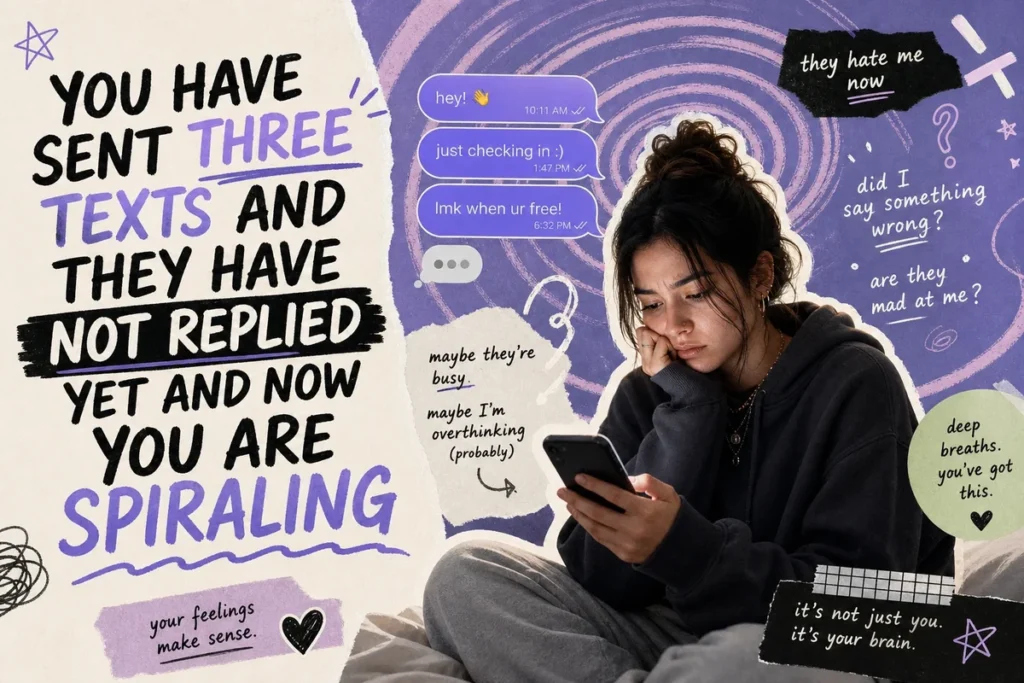
You sent the first text an hour ago. Casual. Light. Then you sent a follow-up because maybe the first one needed context. Then you sent a third because now the silence feels deafening and you need to fill it with something, anything, even if that something is a meme that does not land. Now you are checking your phone every forty-five seconds, watching the notification bar like it owes you money. Your brain is already writing the eulogy for this situationship, this friendship, this whatever-it-is. They are probably showing your texts to their friends. They are probably annoyed. They are probably done with you, and this is how you find out: not through a conversation, but through silence that stretches into hours that feel like days.
This is ADHD texting anxiety, and it is one of the most exhausting parts of having this brain in the age of instant communication.
Why ADHD Texting Anxiety Hits Different
Here is what neurotypical people do not understand about the waiting: it is not that you are impatient. It is not that you are clingy. It is that your brain has a fundamentally different relationship with uncertainty, and silence from someone you care about registers as a threat.
The ADHD brain is already operating with lower baseline dopamine. When you send a text, you get a tiny hit of anticipation, the promise of connection. When the reply does not come, that dopamine pathway does not just go quiet. It starts screaming. The absence of the expected reward feels worse than if you had never sent the text at all.
Add rejection sensitive dysphoria to the mix and you have a perfect storm. RSD is the intense emotional response to perceived rejection or criticism. The key word is perceived. You do not need actual evidence that someone is upset with you. Your brain will manufacture it from silence, from a period instead of an exclamation point, from the gap between their usual response time and this one.
The silence is not information. Your brain is treating it like a verdict.
Dr. William Dodson, who has spent decades researching ADHD emotional dysregulation, describes RSD as causing emotional pain that can feel unbearable and inescapable.1 And nothing triggers it quite like the ambiguity of unread messages.
The Double-Texting Shame Spiral
So you double-texted. Maybe you triple-texted. And now you are not just anxious about the original silence. You are anxious about the fact that you could not handle the silence. You are scrolling back through your messages, counting how many times you texted versus how many times they did. You are calculating ratios. You are forensically analyzing the conversation for signs of imbalance.
ADHD double texting is not about being desperate. It is about impulse control, emotional regulation, and the desperate need to resolve ambiguity. Your brain cannot sit with the open loop. It needs closure, even if that closure is you making things worse by sending another message.
This is the part that feels the most shameful: you know you should wait. You have read the articles about playing it cool. You have told yourself a hundred times that you will not be the person who sends five texts in a row. And then you do it anyway, because in the moment the discomfort of uncertainty is so acute that any action feels better than sitting with it.
The impulsivity that makes you interrupt people in conversations, that makes you buy things you do not need, that makes you start projects you will not finish: it is the same impulsivity that makes you hit send on a text you know you should not send.
What is actually happening: Your prefrontal cortex, the part that handles impulse control, is already working harder than most people's just to get through a normal day. By the time you are in an emotional state about texting, it is exhausted. The urge to send another message is not a character flaw. It is a depleted brake system.
ADHD Situationship Overthinking: When the Stakes Feel Life-or-Death
If you are in a situationship, all of this gets amplified by about a thousand percent. Because situationships are built on ambiguity. There are no clear rules. There is no defined relationship status to fall back on. You cannot reassure yourself with "they are my partner, they love me, they will text back" because you do not actually know what you are to each other.
ADHD situationship overthinking is a special kind of hell because your brain is trying to find patterns and certainty in a situation designed to resist both. You are analyzing response times, emoji usage, the difference between "haha" and "lol" and what it means that they switched from one to the other. You are building elaborate theories from fragments.
The neurotypical advice here is always "just relax" or "do not overthink it." As if you have not tried that. As if relaxing in uncertainty is something you can just decide to do when your brain is wired to treat ambiguity as danger.
What nobody tells you is that this overthinking is your brain trying to protect you. It is scanning for threats. It learned somewhere along the way that people can leave without warning, that connections are fragile, that you need to stay vigilant or you will miss the signs that someone is pulling away. The scanning feels essential because it has felt essential before.
Why Your Phone Is a Dopamine Slot Machine
There is a reason you cannot stop checking. Every time you look at your phone and there is no notification, you get a tiny hit of disappointment. But every time there is a notification, even if it is not from them, you get a tiny hit of hope. This is called variable ratio reinforcement, and it is the same mechanism that makes slot machines addictive.2
For the ADHD brain, this is exponentially more powerful. We are already dopamine-seeking. Our brains are already tuned to chase rewards and struggle to regulate emotional responses to getting or not getting them. The smartphone notification system was designed to be addictive for everyone. For us, it is a direct line to our most vulnerable wiring.
When you are waiting for a text from someone you care about, every phone check is a pull of the lever. And because the reward is inconsistent, you keep pulling. You cannot logic your way out of a system designed to exploit the exact neurotransmitter you are already short on.
You are not weak for checking your phone constantly. You are a person with a dopamine regulation disorder interacting with a device optimized to exploit dopamine regulation.
The Shame Makes It Worse
Here is what happens after the spiral: you feel ashamed. You feel like you overreacted. You feel like a normal person would not have spent three hours analyzing text messages. You feel like there is something fundamentally wrong with you, something beyond ADHD, something about your character.
This shame is part of the cycle. Shame depletes the same emotional resources you need to regulate your responses. So you spiral, then you feel ashamed of spiraling, then you have fewer resources to handle the next trigger, then you spiral harder. The shame is not teaching you anything. It is making you worse at handling this.
ADHD texting anxiety is not a moral failing. It is a predictable response from a brain with specific differences in emotional regulation, impulse control, and dopamine processing. Knowing this does not make the anxiety disappear, but it does make the shame unnecessary.
What Actually Helps When You Are Mid-Spiral
You do not need platitudes about self-worth. You need concrete interventions that account for how your brain actually works.
Put the phone somewhere else. Not on silent in your pocket. In another room. The goal is not to stop thinking about it. The goal is to add friction between the urge to check and the action of checking. Your prefrontal cortex cannot override the impulse, but your legs can be too lazy to walk to the kitchen.
Set a response window. Tell yourself you will not check for twenty minutes. Set a timer. When the timer goes off, you can check. This gives your brain a promise: you will get to resolve the uncertainty, just not right now. Sometimes the promise is enough to get through the next few minutes.
Write out the story your brain is telling. Literally write it. "They did not respond because they are showing our conversation to their friends and everyone is laughing at how pathetic I am." Read it back. Notice that when the thought is external, when it is on paper instead of looping in your head, it sounds different. Less like truth, more like anxiety.
Shift the dopamine source. Text someone else. Not about this situation. Just text a friend about something unrelated. Your brain is seeking a communication hit. Give it one from a different source.
The 10-10-10 trick: Ask yourself: How will I feel about this text in 10 minutes? 10 hours? 10 days? This creates artificial distance from the urgency. In 10 days, you will not remember the hours you spent spiraling. The intensity you feel right now is not predictive of actual importance.
ADHD Impulsivity in Relationships: The Bigger Pattern
The texting anxiety is not an isolated issue. It is part of a larger pattern of ADHD impulsivity in relationships. The same brain that makes you send the third text also makes you overshare on the first date. It makes you fall fast and hard. It makes you say things you have not fully thought through because the impulse to connect overwhelms the impulse to be strategic.
This impulsivity is a double-edged sword. It can make you exciting, passionate, deeply engaged. It can also make you feel like you are always doing too much, always scaring people off, always a few texts away from being too much.
The key is not eliminating the impulsivity. That is probably not possible, and it would mean losing some of your best qualities too. The key is building systems that protect you from the impulsivity when it is working against you. A delay before sending. A trusted friend who gets a screenshot before you hit send. A phone that is not always within arm's reach.
You are not trying to become a different person. You are trying to create an environment where your person can thrive without constantly sabotaging yourself.
When They Finally Text Back
Here is the thing that will make you want to scream: when they finally respond, it is usually fine. They were at work. Their phone died. They saw it but got distracted. They had no idea you were spiraling because to them, a few hours between texts is normal.
This is the gap that causes so much pain. Your experience of the silence was intense, consuming, hours of your life. Their experience was nothing. They were not thinking about it at all. And now you have to pretend your response is casual, that you did not just spend an entire afternoon constructing elaborate rejection narratives.
This gap does not mean you are crazy. It means you have a different nervous system than they do. Time feels different when you are waiting. Uncertainty weighs more. The space between messages is not neutral for you the way it is for them.
Some people will understand this, eventually, if you tell them. Some people will not. The ones who cannot understand that your brain works differently are probably not the ones you want to be in a relationship with anyway, situationship or otherwise.
You Are Not Too Much
You have probably been told, explicitly or implicitly, that the way you text is too much. Too many messages. Too fast. Too eager. Too intense. You have probably tried to be less, to mask the anxiety, to perform the casual detachment that seems to come so easily to everyone else.
But the intensity is not actually the problem. The ADHD texting anxiety is about the mismatch between what you are feeling and what you have to hide. You are not too much. You are just not understood.
The person who is right for you will not need you to pretend you do not care about hearing from them.
This does not mean you should not build skills around managing the anxiety. You should. The spiral is painful for you, regardless of what anyone else thinks. But you are building those skills for your own wellbeing, not because there is something wrong with wanting to feel connected to the people you care about.
The ADHD brain craves connection and struggles with the uncertainty that connection requires. Both things are true. Learning to sit with uncertainty is a skill worth developing, and it is also okay to acknowledge that it will always be harder for you than for someone whose dopamine system is not already working overtime.
The next time you find yourself three texts deep in a spiral, try to remember: this feeling is temporary, the shame is unnecessary, and your brain is doing exactly what it was wired to do. That does not make the anxiety less real. It just makes it less personal.
You are not broken. You are just waiting for a text with a brain that was never designed to wait.
1 Dodson, W. (2022). Rejection Sensitive Dysphoria and ADHD. ADDitude Magazine.
2 Alter, A. (2017). Irresistible: The Rise of Addictive Technology and the Business of Keeping Us Hooked. Penguin Press.
Rate this article
Was this a useful hit?