Black, Brown, and Still Waiting for Someone to Take You Seriously

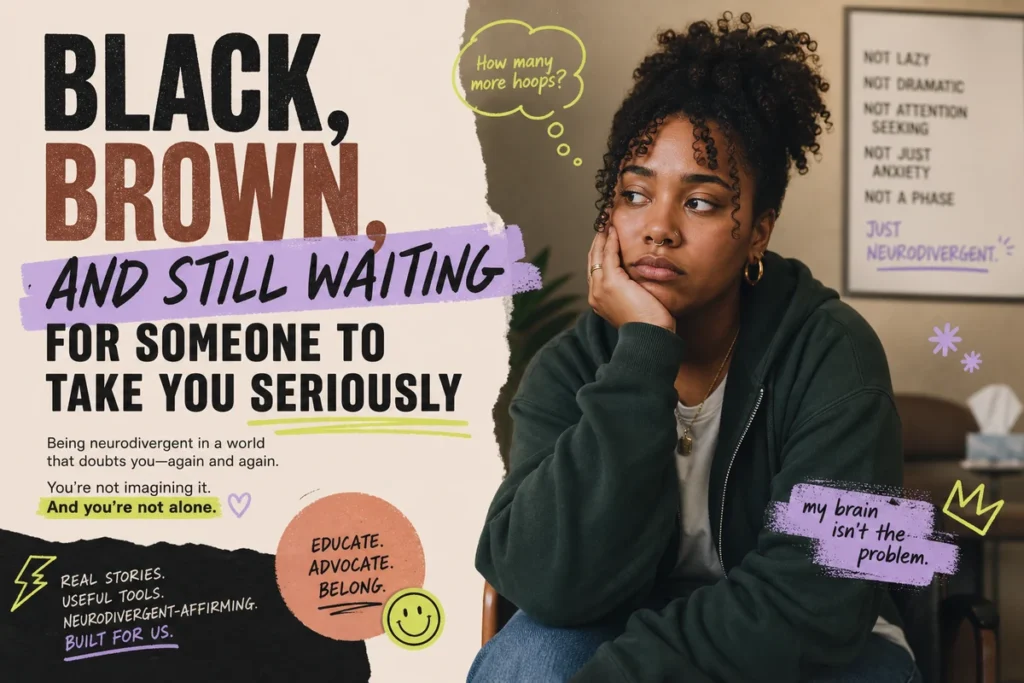
You've read the symptom lists. You've watched the TikToks. You've sat with the realization that your entire life suddenly makes sense through this lens. And then you tried to get help, and the person across from you looked at you like you were making it up.
Or worse: they saw something else entirely. Anxiety. Depression. "Stress." An attitude problem. Something that needed to be medicated into compliance rather than understood.
If you're a Black or brown adult trying to get an ADHD diagnosis, you're not imagining the extra weight you're carrying. The system wasn't built to see you. It was built to see a very specific version of ADHD: a hyperactive white boy bouncing off the walls in a suburban classroom. Everyone else has been trying to fit themselves into that mold ever since, and for adults of color, the mold doesn't just not fit. It actively works against you.
ADHD Diagnosis Black Adults Face: The Numbers Don't Lie
Let's start with what the research actually shows, because you deserve to know this isn't in your head.
A 2021 study published in JAMA Network Open found that Black children were 70% less likely to be diagnosed with ADHD by kindergarten compared to white children.1 Seventy percent. That's not a gap. That's a canyon. And those undiagnosed kids? They grow up into undiagnosed adults who've spent decades thinking they're lazy, broken, or just not trying hard enough.
The American Psychological Association has documented that this disparity doesn't magically correct itself in adulthood.2 Adults of color continue to face lower diagnosis rates, not because they have less ADHD, but because the entire diagnostic pipeline is riddled with bias at every single step.
You're not being paranoid. You're being observant.
Why the System Keeps Missing You
There's no single villain here. It's a whole network of failures that compound on each other, and understanding them can help you navigate around them.
The symptom translation problem. ADHD symptoms look different depending on cultural context, gender presentation, and survival strategies you've developed. If you grew up in a household where "sitting still and being quiet" was survival, you learned to mask early. If your school interpreted your restlessness as defiance rather than dysregulation, you learned to internalize it. The hyperactive white boy template doesn't account for code-switching, for cultural expectations around composure, for the way Black and brown kids get pathologized for behaviors white kids get supported for.
The misdiagnosis pipeline. Research consistently shows that Black children exhibiting ADHD symptoms are significantly more likely to be diagnosed with conduct disorder or oppositional defiant disorder instead.3 These aren't just different labels. They're different trajectories. One leads to support and accommodation. The other leads to discipline, suspension, and a paper trail that follows you. By adulthood, you might have a history of "behavioral problems" that obscures the ADHD underneath, and clinicians see what the file tells them to see.
Provider bias. Implicit bias in healthcare isn't a theory. It's documented across every specialty, and mental health is no exception. When a Black adult describes executive dysfunction, it might get heard as "not motivated." When a Latina woman describes emotional dysregulation, it might get heard as "dramatic" or "hormonal." When anyone of color describes struggling to hold down a job or finish school, the assumption often lands on character rather than neurology.
The same symptoms that get a white person fast-tracked to an ADHD assessment get a person of color routed through anxiety screenings, depression inventories, or worse: dismissal.
The Late Discovery Tax
Here's what decades of missed diagnosis actually cost you, because it's not abstract. It's your life.
Every job you lost because you couldn't make yourself care about pointless tasks, even though you desperately needed the money. Every relationship that imploded because you forgot things that mattered, or said things impulsively, or couldn't explain why you were like this. Every degree you didn't finish, every opportunity you watched yourself self-sabotage, every time you white-knuckled your way through something everyone else seemed to do effortlessly.
Late discovery for ADHD diagnosis Black adults experience means years of compound interest on shame. It means building your entire self-concept around being "the one who can't get it together" without ever knowing there was a reason. It means internalizing the same narratives the system projected onto you.
And then when you finally start to see it clearly, you have to fight the same system to get help.
This is not about excuses: Understanding that you faced systemic barriers doesn't mean you're off the hook for your life. It means you finally have accurate information. You can't navigate a maze if no one told you the walls were there.
The Masking Double Bind
If you're a person of color with ADHD, you've probably become an expert at masking without even realizing it had a name. But you're not just masking ADHD. You're masking while code-switching while managing the cognitive load of existing in spaces that weren't designed for you.
This is exhausting on a level that most ADHD content doesn't address. You're not just hiding your symptoms. You're performing competence in a way that Black and brown people are constantly required to do to be taken seriously. You're managing your tone, your appearance, your perceived attitude, all while your executive function is screaming.
And the cruel irony: the better you mask, the less likely you are to get diagnosed. You've adapted so well to an impossible situation that clinicians look at you and see someone "functioning." They don't see the cost. They don't see the burnout brewing underneath. They don't see that you're holding together a life that takes three times the effort it should.
Racial disparities ADHD research consistently shows this pattern. The kids who masked the best, who were the most compliant, who developed the most sophisticated coping mechanisms: they're the ones who fall through the cracks. And if you grew up in a community where "struggling" wasn't an option, where you had to be twice as good to get half as far, you learned to mask like your survival depended on it. Because often it did.
How to Actually Get Diagnosed When the System Isn't Looking for You
This is the part where most articles get useless. They tell you to "advocate for yourself" without acknowledging that self-advocacy costs differently when you're already starting from a deficit of credibility. So let's be specific.
Document everything before you walk in. Don't rely on being able to describe your symptoms in the moment. ADHD makes self-reporting unreliable, and stress makes it worse. Write down concrete examples: times you've lost jobs, relationships that failed because of ADHD symptoms, daily struggles that match the diagnostic criteria. Bring a list. Refer to it. This isn't you being dramatic. This is you providing data.
Name the pattern directly. If a provider seems to be steering you toward an anxiety or depression diagnosis, you can say: "I want to specifically explore ADHD. I've noticed these symptoms, and I'd like an assessment for that before we attribute everything to anxiety." You're allowed to do this. You're allowed to redirect the conversation toward the evaluation you're actually there for.
Find providers who get it. This isn't always possible, but when it is, it matters. Black and POC therapists, ADHD specialists who explicitly mention working with diverse populations, providers who have done the implicit bias training and actually understand how presentation differs across cultures. Online directories like Therapy for Black Girls, Latinx Therapy, and Inclusive Therapists can help you find someone less likely to filter your symptoms through the wrong lens.
Consider telehealth. Geographic limitations hit harder in underserved communities. If there's no ADHD-informed provider near you, telehealth expands your options. Some states have better telehealth laws than others, but this is worth exploring if local options are failing you.
You are not asking for special treatment. You are asking for accurate treatment. There's a difference, and you're allowed to insist on it.
The Emotional Weight of Being Your Own Advocate
Let's be honest about something: this is exhausting. Having to research racial disparities ADHD just to understand why no one's helping you. Having to walk into appointments armored with documentation because you know you won't be believed otherwise. Having to do the emotional labor of educating providers about their own blind spots while also trying to get help for a condition that makes emotional labor harder.
It's not fair. And sitting with that unfairness matters, because pretending it doesn't hurt won't make it stop hurting.
ADHD already comes with rejection sensitivity. Add the weight of racial microaggressions in healthcare settings, of being dismissed or pathologized, of having to prove your own experience is real. That's a lot. The frustration you feel isn't a character flaw. It's a rational response to an irrational situation.
Your anger is information: If you leave medical appointments feeling worse than when you walked in, that's data about the provider, not about you. You're allowed to fire clinicians who make you feel crazy for describing your own brain.
Finding Your People
The ADHD community online is massive, and within it, there are spaces specifically for people of color navigating these exact issues. Finding them can be the difference between feeling completely alone and realizing you're part of a much larger pattern.
Look for: Black ADHD communities on Reddit and Twitter. Latinx and ADHD hashtags on TikTok. Instagram accounts run by POC with ADHD sharing their experiences. These aren't just support groups. They're information networks. People share which providers actually helped, which assessments are more bias-resistant, which coping strategies work when standard ADHD advice assumes a different life context.
This isn't about finding an echo chamber. It's about finding people who understand the specific intersection you're navigating. People who won't make you explain why "just use a planner" isn't the solution when executive dysfunction is wrapped up in code-switching fatigue and the mental load of existing in spaces that weren't built for you.
What Actually Helps After Diagnosis
Getting the diagnosis is step one. What comes after is building a life that works for your actual brain, not the brain the system assumed you had.
Medication can be transformative. It can also be complicated by providers who under-prescribe to Black patients (documented), who express more suspicion about stimulant prescriptions to people of color (also documented), who require more "proof" of symptoms before considering pharmacological treatment. Know this going in. If a provider is gatekeeping medication in ways that feel racially coded, trust your gut.
Therapy with the right provider can help you untangle decades of shame from the actual symptoms. CBT for ADHD works differently than generic talk therapy. It focuses on building structures and systems rather than processing feelings about why you struggle. Both might be useful, but specificity matters.
And honestly: the single most helpful thing might be accurate self-understanding. When you know that your brain works differently, and that the barriers you faced were systemic rather than personal, it changes how you relate to your own history. You can stop asking "why am I like this" and start asking "what does my brain actually need."
This Is About More Than You
Every time a Black or brown adult pushes through the barriers to get an accurate ADHD diagnosis, you're doing something bigger than solving your own problem. You're creating a data point that makes the next person slightly more visible. You're potentially raising kids who won't have to wait three decades to understand their own brains. You're shifting the pattern, even if it doesn't feel like it.
ADHD diagnosis Black adults navigate changes medicine, slowly, one stubborn case at a time. That's not nothing. It's not fair that it falls on you, but it's also not nothing.
You deserved to be seen earlier. You deserved support in childhood that accounted for your actual brain rather than filtering it through bias. You deserved to grow up understanding yourself instead of internalizing someone else's failure to understand you.
You didn't get that. And now you get to decide what happens next, with better information than you've ever had before. That's not enough, but it's something. And something is where change starts.
1 Coker TR, et al. "Racial and Ethnic Disparities in ADHD Diagnosis and Treatment." JAMA Network Open, 2021.
2 American Psychological Association. "Disparities in ADHD Diagnosis and Treatment in Black Communities." APA Blog, 2022.
3 Fadus MC, et al. "Racial Disparities in Elementary School Disciplinary Actions: ADHD and Conduct Disorder." Journal of Clinical Psychiatry, 2020.
Rate this article
Was this a useful hit?