Nobody Warned You That Newborns Are a Sensory Ambush

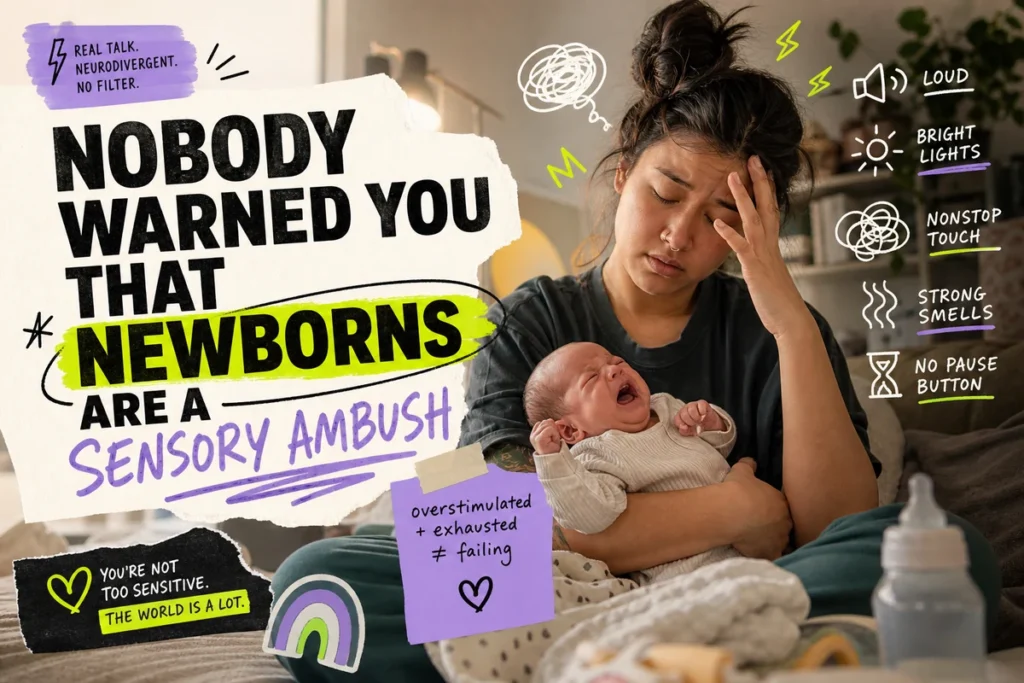
You're standing in the kitchen at 3am, formula crusted on your shirt, and the baby is crying again. But that's not why you're frozen. You're frozen because the refrigerator is humming, the hallway light is flickering, your partner is breathing too loud from the couch, and somehow all of it is happening at maximum volume inside your skull. The baby's cry isn't just a sound. It's a physical sensation that crawls under your skin. And somewhere in the back of your mind, a voice is saying: other parents don't feel like this. Other parents aren't falling apart.
Here's the thing nobody told you: ADHD postpartum overwhelm is a biological reality, not a personal failing. Your brain isn't broken because you're struggling. Your brain is struggling because its entire chemical foundation just got demolished by pregnancy, birth, and the neurological assault of new parenthood. And the parenting content you're doom-scrolling at 4am? It was written for neurotypical brains. It doesn't apply to you.
Why ADHD Postpartum Overwhelm Hits Different
Let's start with the numbers, because you deserve to know this isn't just you. Women with ADHD are five times more likely to develop postpartum depression and six times more likely to develop postpartum anxiety than neurotypical women.1 A Canadian longitudinal study found that ADHD mothers have 70% higher odds of postpartum depression even when controlling for other factors.2 This isn't a character flaw. This is epidemiology.
The reason comes down to chemistry. During pregnancy, estrogen levels rise dramatically. Estrogen directly influences dopamine signaling in the brain, which is why some people with ADHD actually feel better during pregnancy. Their baseline dopamine function improves temporarily. Then the baby arrives, estrogen plummets within 24 to 48 hours of birth, and the dopamine system that was barely functional to begin with? It crashes harder than it's ever crashed.
You're not imagining that your ADHD symptoms are worse postpartum. They are objectively, measurably worse. Your working memory, already compromised by ADHD, is now also compromised by sleep deprivation. Your emotional regulation, already difficult, is now operating with about 40% of its normal dopamine supply. Your sensory processing, which may have always been sensitive, is now on high alert 24/7 because your nervous system has correctly identified that a tiny human's survival depends on you.
The Sensory Ambush Nobody Mentioned
Parenting books talk about the sleep deprivation. They mention the feeding schedules. They occasionally acknowledge that it's "hard." What they don't mention is that newborns are a sensory environment, not just a responsibility. And for the ADHD brain, that environment can be genuinely intolerable.
The crying isn't just loud. It's evolutionarily designed to be the most distressing sound your nervous system can process. Your brain is supposed to react urgently to infant crying. But the ADHD brain, already prone to sensory overwhelm, doesn't just react. It floods. The sound doesn't register as "baby needs something." It registers as "emergency, danger, everything is wrong, make it stop."
Then there's the touch. The constant, endless physical contact. For people with ADHD who also have sensory processing differences (which is most of us), being touched all day isn't comforting. It's overstimulating. The baby wants skin to skin. The baby needs to be held. The baby falls asleep on you and you can't move for two hours and every nerve in your body is screaming to get away and you feel like a monster for wanting to put your own child down.
This is ADHD new parent sensory overload. It's real. It's common. And it doesn't mean you don't love your baby.
You can love someone completely and still need to put in noise-canceling headphones while you hold them. Those two things aren't contradictions. They're survival.
The Guilt Spiral You're Probably In
Here's what typically happens. You hit a moment of overwhelm. Maybe you put the baby down in a safe place and walked away to stand in the garage for five minutes. Maybe you snapped at your partner. Maybe you just sat on the bathroom floor and cried. Normal responses to an abnormal level of stress.
But then your brain does what ADHD brains do. It takes that moment and runs it on repeat. You should be grateful. Other people want babies and can't have them. Your baby deserves a better parent. You're failing. You're broken. Maybe you shouldn't have done this. The guilt becomes another source of overwhelm, and now you're drowning in both the original stress and the shame about how you're handling it.
This is the ADHD mom burnout newborn trap. The burnout causes the guilt, the guilt amplifies the burnout, and the cycle accelerates until you're barely functional and completely convinced it's your fault.
It's not your fault. Your brain is doing exactly what a dopamine-depleted, sleep-deprived, hormonally devastated nervous system does. You're not failing parenthood. You're experiencing ADHD postpartum overwhelm in a culture that refuses to acknowledge it exists.
The Estrogen-Dopamine Connection Nobody Explained
Let's get specific about what's happening in your brain, because understanding the mechanism can help you stop blaming yourself for it.
Estrogen modulates dopamine receptors, particularly in the prefrontal cortex (where executive function lives) and the limbic system (where emotional regulation happens). When estrogen is high, dopamine signaling improves. When estrogen drops, dopamine signaling gets worse. This is why some people with ADHD notice their symptoms fluctuate with their menstrual cycle, getting worse in the luteal phase when estrogen drops.
Now imagine that normal monthly fluctuation, but make it the biggest estrogen drop your body has ever experienced. That's postpartum. In the span of days, you go from the highest estrogen levels of your life to some of the lowest. Your dopamine system, already running on fumes because that's just how ADHD works, suddenly loses one of its main supports.
The ADHD estrogen dopamine postpartum crash is biological: It's not about wanting motherhood enough. It's about neurochemistry. Your symptoms aren't a sign of inadequacy. They're a predictable response to a massive hormonal shift that hits ADHD brains harder than neurotypical ones.
This also explains why postpartum depression and anxiety are so much more common in ADHD mothers. Depression and anxiety aren't separate from ADHD. They're what happens when an already-vulnerable dopamine system gets pushed past its breaking point. Your brain literally doesn't have the chemical resources to regulate mood, attention, and sensory input simultaneously.
What Actually Helps (Not What the Parenting Books Say)
Standard postpartum advice assumes a neurotypical brain. "Sleep when the baby sleeps." Great, except ADHD brains often can't fall asleep on command, and even if you do sleep, you might wake up more disoriented and dysregulated than before. "Accept help." Wonderful, except help often means people in your space, touching your things, adding more sensory input.
Here's what actually helps ADHD postpartum overwhelm:
Protect your ears. Noise-canceling headphones or high-fidelity earplugs aren't luxury items. They're medical equipment. You can still hear the baby, but the frequencies are dampened enough that your nervous system can stay regulated. Some parents wear them during every feeding. Some parents wear them most of the day. There is no wrong amount.
Create sensory breaks, not just time breaks. Five minutes in a dark, quiet room is worth more than thirty minutes in a living room where you can still hear everything happening. When people offer help, be specific: "I need 20 minutes alone in a room with the door closed. The baby doesn't need to leave the house. I just need silence."
Lower your standards to the floor, then lower them again. The ADHD brain is already struggling with task initiation and follow-through. Postpartum, those struggles multiply. Your job right now is to keep a baby alive. That's it. Not to have a clean house. Not to send thank-you cards. Not to look put-together. Not to feel bonded. Just alive. Everything else is optional until your brain has more resources.
Tell someone how bad it actually is. Not the softened version. Not "it's hard but we're managing." The real version. The "I had to leave the room because I couldn't stand the sound of my own baby" version. The "I don't feel connected and I'm scared that means something is wrong with me" version. ADHD isolation makes everything worse. One honest conversation with a partner, friend, or provider can break the shame spiral.
You don't need to be fixed. You need support that's actually designed for how your brain works, not generic advice that assumes you're starting from neurotypical baseline.
When It's More Than Overwhelm
ADHD postpartum overwhelm is distinct from postpartum depression and anxiety, but they can overlap. The key question isn't "am I struggling?" because of course you're struggling. The key questions are about trajectory and intensity.
Are things getting slightly better week over week, even if "better" is still hard? That's probably adjustment plus ADHD. Are things getting worse, or staying unbearably bad with no improvement? That might be PPD or PPA on top of ADHD, and it needs professional support.
Do you have moments of connection or relief, even if they're brief? That's probably adjustment plus ADHD. Do you feel nothing but numbness, dread, or rage, with no breaks? That might be clinical depression or anxiety that needs treatment.
ADHD postpartum depression is significantly underdiagnosed because providers often attribute the symptoms to "adjustment" or "just how new parenthood is." If you feel like something is seriously wrong, trust that instinct. Push for screening. Get a second opinion if you need to. Your brain is already running a deficit, and untreated mood disorders will make the ADHD exponentially harder to manage.
This is worth saying directly: If you're having thoughts of harming yourself or the baby, call a provider today. Not because you're a danger or a bad parent, but because intrusive thoughts are a medical symptom that responds to treatment. You can get better. This doesn't have to be how the rest of parenthood feels.
The Long Game: It Does Get Better, But Not Automatically
Around three to four months postpartum, estrogen levels begin to stabilize. If you're not breastfeeding, this happens faster. If you're breastfeeding, estrogen stays suppressed for longer, which means dopamine stays impaired for longer. This isn't an argument against breastfeeding. It's information you deserve to have when making decisions about your body and your brain.
Sleep also starts to consolidate. Most babies begin sleeping longer stretches, and even small improvements in sleep can significantly improve ADHD symptoms. The first time you get a four-hour block of uninterrupted rest, you might feel like a different person. You're not. You're the same person, just with slightly more dopamine.
What doesn't improve automatically is the coping structures. The sensory management strategies, the communication patterns with your partner, the relationship with your own expectations. Those require intentional work, ideally with a provider who actually understands ADHD. The acute crisis passes. What you build to replace it matters.
ADHD postpartum overwhelm is not a permanent state. It's the first chapter of a longer story. But the first chapter is brutal, and you deserve to have someone acknowledge that instead of telling you to cherish every moment.
You're Not Broken, You're Flooded
The way you're feeling right now isn't a reflection of how much you love your baby. It's a reflection of how much your nervous system is being asked to process with drastically reduced resources. The crying that makes you want to scream isn't evidence of bad parenting. It's evidence of a sensory system that's been pushed past capacity. The guilt that tells you everyone else handles this better isn't truth. It's the ADHD brain doing what it does: comparing your insides to other people's outsides and finding yourself deficient.
You're in the hardest phase of early parenthood, made harder by a brain that was already working overtime just to function in the neurotypical world. That's not failure. That's mathematics. When you add severe hormonal disruption plus sleep deprivation plus constant sensory input to an existing dopamine deficit, you get exactly this: overwhelm that feels unsurvivable.
It is survivable. Not through willpower or gratitude or trying harder. Through understanding what's actually happening, lowering expectations ruthlessly, protecting your sensory environment, and asking for help that actually matches what your brain needs. ADHD postpartum overwhelm responds to strategy. It doesn't respond to shame.
The baby will get older. Your hormones will stabilize. Your sleep will improve. And you'll still have ADHD, but you'll have it with more resources and more information than you have right now. This moment isn't forever. It just feels like forever because that's what overwhelm does.
You're going to get through this. Not because you're strong (though you are). Because this phase ends, and you're still going to be here when it does.
1 Massachusetts General Hospital Center for Women's Mental Health, 2023 research summary on ADHD and perinatal mood disorders.
2 Canadian longitudinal study on maternal mental health outcomes, published findings on ADHD as independent risk factor for postpartum depression.
Rate this article
Was this a useful hit?