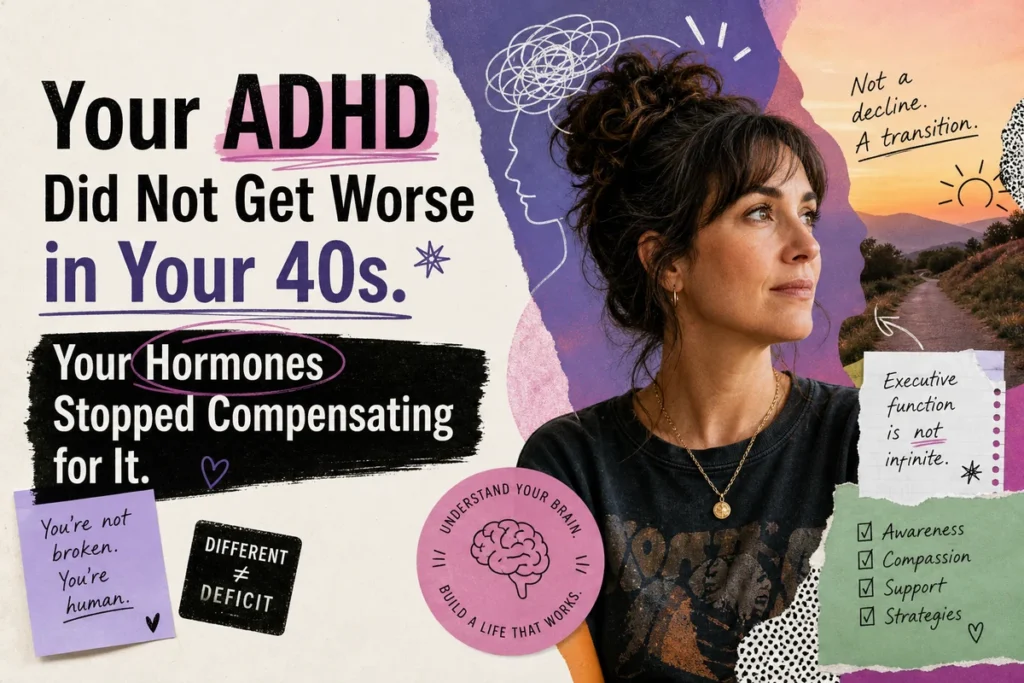
Your ADHD Did Not Get Worse in Your 40s. Your Hormones Stopped Compensating for It.

You used to be able to hold it together. Not perfectly, but well enough. You had your systems, your workarounds, your particular way of muscling through the chaos in your head. Maybe you were never officially diagnosed with anything. Maybe you just thought you were "scattered" or "intense" or "bad with time." But you managed. You built a career. You raised kids. You kept the wheels on.
And then, somewhere in your late 30s or early 40s, the wheels started coming off. Not slowly. Not gracefully. Just: off. The focus you used to summon with enough coffee and pressure? Gone. The emotional regulation you white-knuckled your way through? Shattered. The ability to start tasks, finish tasks, remember tasks? Evaporated into some fog you cannot name.
You are not imagining this. You are not weak. You are not suddenly incompetent at the job you have done for fifteen years. What is happening has a name, and it is not "getting older" or "too much stress." It is ADHD perimenopause symptoms worsening, and there is a direct biological reason your brain feels like it has been unplugged.
ADHD Perimenopause Symptoms Worsening: This Is Not a Coincidence
Here is the thing no one told you: if you have ADHD, your symptoms are hormone-sensitive. Estrogen is not just about reproduction. It is deeply involved in the production, transport, and reception of dopamine in your brain. Dopamine is the neurotransmitter that governs attention, motivation, emotional regulation, and executive function. It is the exact neurotransmitter that is already dysregulated in ADHD brains.
For your entire adult life, estrogen has been quietly doing backup work for your dopamine system. Not fixing the ADHD, but compensating. Smoothing over some of the gaps. Making your existing coping strategies functional enough to pass.
And then perimenopause begins. Estrogen starts fluctuating wildly, then declining. And with it goes the support system your brain did not know it was depending on.
A 2025 population-based cohort study published in BMC Medicine found that women with ADHD experience significantly more severe perimenopausal symptoms than neurotypical women, and that the worsening of ADHD symptoms tracks directly with hormonal decline.1 This is not correlation without causation. The mechanism is clear: less estrogen means less dopamine support means ADHD symptoms that were manageable become unmanageable.
The Timeline No One Warns You About
Most people think menopause is the moment your period stops. But perimenopause, the transitional phase, can begin up to 10 years earlier. That means if menopause typically occurs around 51, perimenopause can start in your early 40s. Or your late 30s. Or, for some people, even earlier.
This is why so many women with undiagnosed ADHD finally seek evaluation in their 40s. They have been compensating their entire lives, and suddenly the compensation stops working. The symptoms that were always there become undeniable.
The moment I could not remember my own phone number while standing in a store was the moment I knew something was genuinely wrong. I had been forgetting things for months, but this was different. This was my brain refusing to retrieve information I have known for twenty years.
This experience, or some version of it, is staggeringly common. An ADDitude Magazine survey found that 94% of respondents reported worsening ADHD symptoms during perimenopause.2 Ninety-four percent. This is not a subset of unlucky people. This is nearly everyone.
The Estrogen-Dopamine Connection Your Doctor May Not Know
Let's get specific about the science, because understanding why this is happening is part of taking it seriously.
Estrogen affects dopamine in three distinct ways:
Production: Estrogen increases the synthesis of dopamine in key brain regions, including the prefrontal cortex (executive function) and the limbic system (emotional regulation).
Transport: Estrogen modulates dopamine transporter activity. When estrogen is high, dopamine sticks around longer in the synaptic space, doing its job. When estrogen drops, dopamine gets reabsorbed too quickly.
Reception: Estrogen upregulates dopamine receptors, making your brain more sensitive to the dopamine that is available. Low estrogen means your receptors become less responsive.
A 2025 systematic review on ADHD and sex hormones confirmed these mechanisms and called for greater clinical awareness of how hormonal transitions affect ADHD symptom severity.3 The researchers emphasized that women with ADHD are particularly vulnerable during perimenopause because they are starting from a baseline of dopamine dysregulation.
The oversimplified version: Estrogen was doing part of your dopamine system's job. Now it is clocking out. Your ADHD did not change. Your hormonal safety net did.
Why This Often Leads to Late Discovery
For women who were never diagnosed with ADHD, perimenopause often triggers the first formal evaluation. The symptoms become impossible to ignore or explain away.
But here is what makes this complicated: the symptoms of perimenopause and ADHD overlap significantly. Brain fog. Memory problems. Sleep disruption. Mood swings. Difficulty concentrating. A doctor who is not looking for ADHD might attribute everything to "normal menopause transition" and send you home with a pamphlet.
This is why late discovery in perimenopause is both common and commonly missed. You need a provider who understands that ADHD and perimenopause can happen simultaneously and interact with each other. You need someone who will not dismiss your cognitive symptoms as just hormonal, but will not ignore the hormonal component either.
If you have been functioning at a high level for decades and suddenly cannot, that is important diagnostic information. It does not mean you do not have ADHD. It may mean you have always had ADHD and your compensatory mechanisms have finally been overwhelmed.
ADHD Perimenopause Symptoms Worsening: What Does This Actually Look Like?
The specific symptoms that worsen during perimenopause tend to cluster around executive function and emotional regulation. Here is what many people report:
Task initiation paralysis: You could always struggle to start things, but you had your hacks. Deadlines, external accountability, adrenaline. Now those hacks do not work. You stare at your to-do list and cannot make yourself begin. The paralysis is more complete than it has ever been.
Working memory collapse: You walk into rooms and forget why. You lose track of conversations while you are still in them. You open your email to do one thing and immediately cannot remember what it was.
Emotional flooding: Small frustrations trigger disproportionate reactions. You cry in the car over minor inconveniences. You feel rage at things that would have annoyed you mildly before. The emotional volume knob is stuck at maximum.
Time blindness intensification: You were never great with time, but now entire afternoons disappear without explanation. You are consistently shocked by how late it is. Deadlines ambush you even when you have been staring at the calendar.
Physical restlessness or new exhaustion: Some people experience an increase in hyperactive symptoms. Others go the opposite direction, experiencing a bone-deep fatigue that makes their previous energy levels seem impossible.
I kept waiting for it to pass. I thought I was tired, then I thought I was stressed, then I thought maybe I was depressed. It took me two years to realize this was not a temporary dip. This was a fundamental shift in how my brain was operating.
The Medical Conversation You Need to Have
Managing ADHD perimenopause symptoms worsening requires addressing both the ADHD and the hormonal transition. These are not separate problems. They interact.
If you are already on ADHD medication, you may notice it working differently at different points in your cycle, or working less effectively overall as perimenopause progresses. This is not you building tolerance. This is your estrogen levels affecting how the medication functions. Some people need dosage adjustments during perimenopause. This is a conversation to have with your prescriber.
Hormone replacement therapy (HRT) is another conversation worth having. For some women with ADHD, stabilizing estrogen levels can significantly reduce symptom severity. This is not about anti-aging or vanity. This is about giving your dopamine system back some of its support structure. HRT is not appropriate for everyone, and it has its own risks and considerations, but it should be part of the evaluation, not dismissed out of hand.
What to ask your doctor: "I have ADHD and I am in perimenopause. I want to discuss how these might be interacting and whether adjustments to my ADHD treatment or consideration of HRT could help stabilize my symptoms."
If your doctor does not take this seriously, find a different doctor. This is not optional. You deserve a provider who understands the estrogen-dopamine connection and will work with you, not dismiss your concerns as normal aging.
What You Can Actually Do Right Now
While you work on the medical side, there are management strategies that help during this transition.
Track your symptoms against your cycle. Even if your periods are becoming irregular, noting patterns can help you anticipate bad days. When you know your focus will be worse, you can schedule accordingly. This is not defeat. This is data.
Externalize everything. Your working memory is compromised. Stop relying on it. Write things down immediately. Set timers for everything. Use visual reminders. Your brain cannot be trusted to hold information right now, so stop asking it to.
Lower the bar on high-fluctuation days. Some days will be worse than others. On those days, do less. Reschedule what you can. This is strategic management, not weakness. You are working with a brain that is receiving less hormonal support. Acting like nothing has changed is not resilience. It is denial.
Protect your sleep fiercely. Perimenopause often disrupts sleep, and sleep deprivation worsens ADHD symptoms. This creates a vicious cycle. Prioritize sleep hygiene even when it feels impossible. Consider whether a sleep study is warranted if you are waking frequently.
Move your body, even briefly. Exercise increases dopamine. It is not a cure, but it helps. On days when you cannot face a workout, a ten-minute walk still matters.
The Grief and the Relief
Learning about the hormone-ADHD connection often brings two conflicting emotions at once.
There is grief: for all the years you blamed yourself for things that had a biological explanation. For the relationships strained, the opportunities missed, the shame you carried. For finding out in your 40s what you should have known in your 20s.
And there is relief: because this makes sense. Because you are not crazy. Because there is a reason the wheels came off and the reason is not some moral failing on your part.
Both feelings are valid. You can hold them at the same time.
When my doctor finally connected the dots, I cried. Not because it was bad news. Because it was the first time in two years that anyone had offered an explanation that did not boil down to "try harder" or "everyone gets forgetful with age."
Understanding ADHD perimenopause symptoms worsening will not fix everything. Your brain is still going through a significant transition. But understanding means you can stop fighting yourself and start working with what is actually happening.
You Are Not Losing Your Mind
If you found this article because you have been searching for answers, because nothing else has explained why you suddenly cannot function the way you used to, here is what I want you to know:
You are not broken. You are not declining. You are not proof that you were never as capable as people thought.
You are a person with an ADHD brain going through a hormonal transition that directly affects dopamine function. The scaffolding that held your symptoms at bay is being dismantled. Of course things are harder. The miracle is that you held it together as long as you did.
This is treatable. This is manageable. This is understood by medicine, even if it is not understood by your current doctor or your family or the voice in your head that keeps insisting you should be able to push through.
You do not have to push through. You have to adapt. And adaptation starts with understanding exactly what you are adapting to.
Your ADHD perimenopause symptoms worsening is real, it is biological, and it is not your fault. Now you know. What you do with that knowledge is up to you.
1 BMC Medicine, 2025. Population-based cohort study on ADHD and perimenopausal symptoms.
2 ADDitude Magazine survey on ADHD and perimenopause, 2023.
3 PubMed, 2025. Systematic review on ADHD and sex hormones across the lifespan.
Rate this article
Was this a useful hit?