Fine at 2pm, Devastated at 2:05, Fine Again by 3. This Is Not Drama. This Is Your Brain.

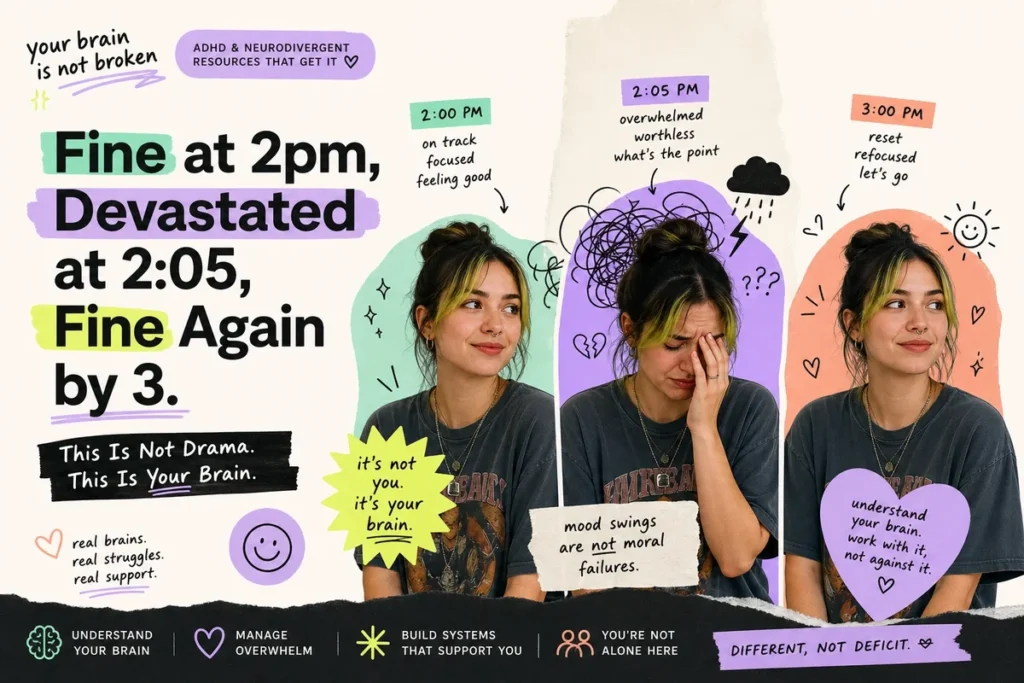
You were fine ten minutes ago. Actually fine. Laughing at something on your phone, thinking about what to make for dinner. Then someone said one thing, or you remembered one thing, or nothing happened at all, and suddenly you're in the bathroom at work trying not to cry. Or you're so angry you can feel your heartbeat in your ears. Or you're convinced everyone secretly hates you and has been pretending this whole time.
And then, somehow, an hour later you're completely okay again. Maybe even confused about why you were so upset. The intensity is gone like it was never there, except for the residue of embarrassment and the familiar thought: what is wrong with me?
This is ADHD emotional whiplash. And if you've spent your whole life being told you're "too sensitive" or "so dramatic" or "overreacting," this article is about to explain something important: you're not doing it on purpose, and you're not making it up. Your brain processes emotions differently than neurotypical brains do. The speed and intensity of your emotional shifts are neurological, not character flaws.
What ADHD Emotional Whiplash Actually Looks Like
It's sobbing in your car over a text that, when you read it again later, seems completely neutral. It's getting so frustrated with a jammed drawer that you want to throw it across the room. It's feeling a wave of love for your friend so intense it almost hurts, then feeling nothing an hour later and wondering if you're a sociopath.
It's the gap between how big the feeling is and how small the trigger was. Your coworker made a joke and everyone laughed, and suddenly you're spiraling into "they all think I'm stupid" even though you know, logically, that's probably not true. But the feeling doesn't care about logic. The feeling is already at a 10 while your rational brain is still catching up.
Here's the part that confuses everyone, including you: it passes. Unlike depression, which settles in and stays, or bipolar mood episodes, which last days or weeks, ADHD emotional whiplash moves through you fast. You're devastated at 2:05, and by 3pm you're genuinely fine. Not pretending to be fine. Actually fine. The storm came and went like it does on summer afternoons: sudden, intense, over.
This is why people don't believe you. They see you crying in the break room and then laughing at happy hour, and they assume one of those was fake. They don't understand that both were completely real. You can contain multitudes in a single afternoon. Lucky you.
The Neuroscience of Why ADHD Emotions Are Too Intense
Your prefrontal cortex is supposed to act like a volume dial for emotions. When something triggers a feeling, that part of your brain should modulate the intensity, keeping it proportional to the situation. Stubbed your toe? That's a 3. Got dumped? That's an 8. Got a weird look from a stranger? That's a 1, maybe a 2 if you're already having a day.
In ADHD brains, that volume dial is unreliable. The prefrontal cortex, which handles executive functions including emotional regulation, is underactive.1 So when an emotion comes in, it doesn't get modulated. It hits you at full volume regardless of whether the trigger warrants it. The weird look from a stranger registers as an 8. The stubbed toe becomes a personal attack by the universe. Everything is louder than it should be.
Dr. Russell Barkley, one of the leading ADHD researchers, has argued for years that emotional dysregulation should be considered a core symptom of ADHD rather than a side effect. His research shows that ADHD impairs the ability to self-regulate emotions just as much as it impairs attention.2 But because the diagnostic criteria focus on attention and hyperactivity, millions of people with ADHD don't know that their emotional intensity is part of the same neurological picture.
You're not more emotional than other people because you're weak or dramatic. You're more emotional because the part of your brain that's supposed to turn down the volume isn't doing its job.
This is also why your emotions move so fast. Neurotypical brains process emotions through a kind of buffer system: the feeling comes in, gets evaluated, gets modulated, and then you respond. ADHD brains skip steps. The feeling comes in and you're already in it before any evaluation happens. But because there was no buffer on the way in, there's also no buffer on the way out. The emotion passes through you quickly because it was never slowed down to begin with.
ADHD Mood Swings Are Not Bipolar, and That Matters
If you've googled "why do my moods change so fast," you've probably encountered bipolar disorder in the search results. And maybe you've wondered. Maybe a therapist who didn't know much about ADHD wondered too. So let's be clear about the difference, because it's significant.
Bipolar mood episodes last days, weeks, or months. A manic episode might last a week. A depressive episode might last two weeks or longer. These are sustained states that affect sleep, energy, behavior, and thinking over an extended period. They're not triggered by specific events in the same way, and they don't resolve in an afternoon.
ADHD emotional dysregulation is reactive and brief. Something triggers you, you spike to 100, and then you come back down. The whole cycle might take twenty minutes or two hours. It's tied to specific moments: someone's comment, a memory, a frustration, a rejection. And when it passes, it actually passes. You're not pretending to feel better. The neurological storm has moved through.
This distinction matters for treatment. Bipolar requires mood stabilizers. ADHD emotional dysregulation often responds to ADHD medication, therapy focused on emotional awareness, and specific regulation strategies. Misdiagnosis in either direction means wrong treatment, which means continued suffering when relief was possible.
Important: If your mood episodes last days or weeks, or if you experience periods of elevated mood with decreased need for sleep and increased energy, talk to a psychiatrist about bipolar screening. ADHD and bipolar can also coexist. The goal isn't to avoid a diagnosis. The goal is to get the right one.
The Parking Lot Crying Phenomenon
There's a specific experience that seems to be universal among people with ADHD emotional whiplash: the parking lot cry. You make it through the meeting, the conversation, the interaction. You hold it together because you have to. And then you get to your car, and everything you were containing comes flooding out.
Maybe it was a performance review that was actually fine but contained one piece of constructive feedback. Maybe it was a friend making a joke at your expense that everyone laughed at. Maybe it was nothing specific at all. Just an accumulation that found its moment.
You sit in the parking lot, crying, feeling like you're falling apart. And then fifteen minutes later, you're driving home listening to a podcast and feeling basically okay. If someone asked you right now what you were crying about, you'd struggle to explain it in a way that makes sense. "My boss said I should work on my email response time" doesn't sound like a reason to sob. But it wasn't about the email response time. It was about the cascade that comment triggered: you're not good enough, everyone knows, you're going to get fired, you're going to fail at everything.
ADHD crying for no reason, or what feels like no reason, is usually this: the emotion is real, but the trigger was small and the reaction was disproportionate. You're not crying about the email feedback. You're crying about a lifetime of feeling like you can't keep up, crystallized in a single moment.
Why Shame Makes ADHD Emotional Whiplash Worse
Here's where it gets cruel: the shame you feel about your emotional reactions actually intensifies them. It's a feedback loop. You have a big reaction. You feel embarrassed about the big reaction. The embarrassment triggers more emotion. Now you're upset about the original thing AND upset about being upset. The spiral deepens.
If you grew up being told you were too much, too sensitive, too dramatic, you internalized those messages. So now, every time you feel something intensely, there's a voice that says "here you go again, being dramatic." That voice adds shame to an already overwhelming emotional experience. You're not just feeling the original emotion. You're feeling the original emotion plus the shame of having the emotion plus the frustration that you can't control it.
The thing that helps most with ADHD emotional whiplash is understanding that it's neurological. Not because understanding makes it stop, but because understanding removes the shame layer. When you know why your brain does this, you can stop hating yourself for it.
This is not about toxic positivity or "loving your ADHD." You don't have to love the parking lot cries. You don't have to be grateful for emotional intensity. But you can stop treating yourself like a broken person who should be able to control this through sheer willpower. The willpower approach has failed you because it was never going to work. Your prefrontal cortex can't willpower its way into functioning differently.
Working With ADHD Emotional Whiplash
You can't eliminate the emotional intensity. That's the hard truth. What you can do is shorten the recovery time, reduce the shame spiral, and get better at riding out the wave without it drowning you.
The first thing that helps is naming what's happening. When you feel the spike starting, when you recognize the familiar signs of an emotional flood incoming, say it out loud or in your head: "This is ADHD emotional dysregulation. This is my brain, not the situation. This will pass." It sounds too simple to work, but naming interrupts the spiral. It creates a tiny gap between you and the emotion where observation can exist.
The second thing that helps is time awareness. Your brain, in the grip of intense emotion, believes the feeling is permanent. It doesn't feel like a wave that will pass. It feels like a new reality you'll live in forever. Reminding yourself that this historically passes quickly creates a survival strategy: you just need to make it through the next twenty minutes. You've done that before. You can do it again.
The third thing that helps is reducing the stakes. Not everything requires an immediate response. If you're flooded, you don't have to reply to the text right now. You don't have to make a decision right now. You can say "I need to think about this" and give yourself time to come back to baseline before you act. The emotions are real, but you don't have to let them drive the car.
Note: ADHD medication helps many people with emotional regulation. If you're on meds and still struggling significantly with ADHD emotional whiplash, it might be worth talking to your prescriber about dosage or trying a different medication. Emotional dysregulation improving is often a sign that your current meds are working well.
What to Tell People Who Don't Get It
You don't owe everyone an explanation. But if you want to explain it to someone who matters, here's a framework that might help:
"My brain doesn't regulate emotions the same way yours does. It's a neurological thing. I feel things really intensely and really fast, and they pass just as fast. So if you see me really upset about something that seems small, I'm not being dramatic. That's genuinely how it registers for me. And if I seem fine an hour later, I'm not faking it. It actually passes that quickly. Both parts are real."
The people who get it will get it. The people who don't might never, and that's information about them, not you.
The Unexpected Upside
This part gets less attention, but it's true: the same mechanism that makes you cry in parking lots also makes you feel joy intensely. Love intensely. Excitement intensely. You're not just more sad or more angry. You're more everything.
When you see a dog on the street and your whole day gets better, that's the same brain. When a song you love comes on and you feel it in your whole body, that's the same brain. When you get good news and the happiness is so big it almost hurts, that's the same brain.
You don't have to perform gratitude for the hard parts to acknowledge that the good parts are real too. Your emotional intensity is a package deal. The lows are lower, yes. But the highs are also higher. That doesn't make the lows worth it, necessarily. But it does make you more than just your struggles.
ADHD emotional whiplash means you experience the full catastrophe of being human, turned up to 11. Some days that's terrible. Some days it's the best part of being you.
The Next Time It Happens
You're going to have another moment where you feel something so intensely it scares you a little. Where the emotion comes out of nowhere and takes you over completely. Where you can't understand, in the moment, how you're ever going to feel normal again.
And then you're going to feel normal again. Probably within the hour.
That's ADHD emotional whiplash. It's not character weakness. It's not drama. It's your brain processing the world without the regulatory buffer that neurotypical brains have. The feelings are real. The intensity is real. And the passing is also real.
You've survived every single one of these episodes so far. You'll survive the next one too. The wave comes in, and the wave goes out. That's the only promise you need: it will pass. It always passes. You just have to make it through until it does.
1 Arnsten, A.F.T. (2009). The Prefrontal Cortex and ADHD. Journal of Pediatrics, 154(5), I-S43.
2 Barkley, R.A. (2015). Emotional dysregulation is a core component of ADHD. In Attention-Deficit Hyperactivity Disorder: A Handbook for Diagnosis and Treatment (4th ed.). Guilford Press.
Rate this article
Was this a useful hit?