Your Brain Will Not Put the Phone Down at 1am. This Is Not a Willpower Problem.

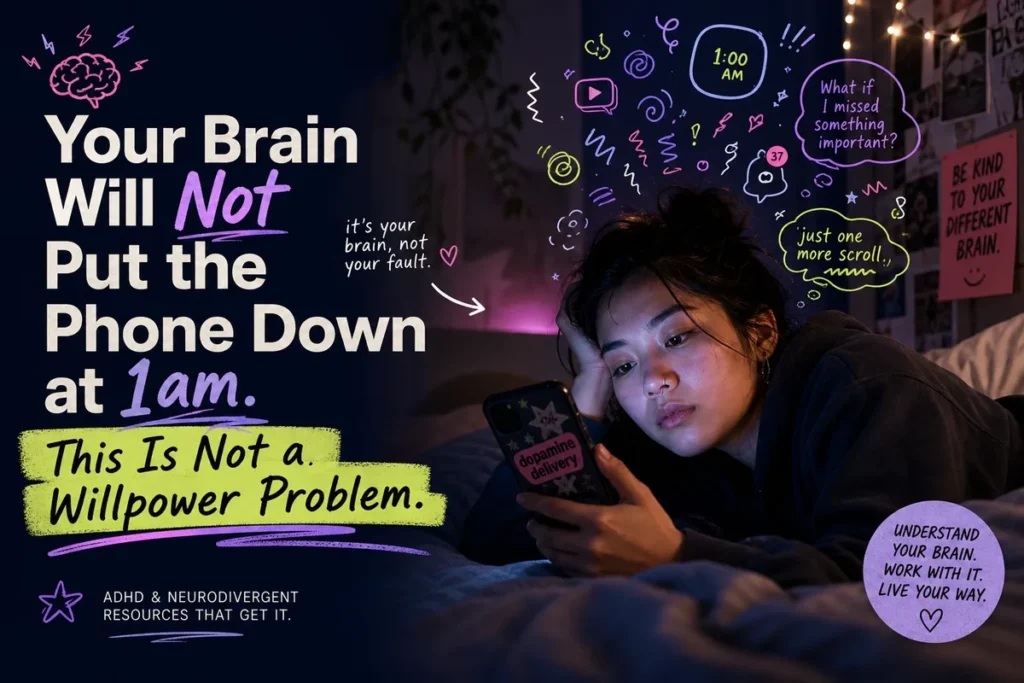
It's 1:47am. You have work in six hours. You know this. You've done the math three times. You told yourself "one more video" at 11:30, then at midnight, then at 12:45. Your eyes are burning. Your body is exhausted. And your thumb keeps scrolling. You watch yourself doing it, fully aware that this is a problem, fully aware that you'll hate yourself tomorrow, and somehow that awareness changes absolutely nothing. The scroll continues. ADHD doomscrolling can't stop on command because this isn't about commands. This is about a brain running a very specific program that has nothing to do with your intentions.
You're not weak. You're not lazy. You're not addicted in the way people throw that word around. What you are is a person with a dopamine-regulation difference holding a device engineered by thousands of people whose entire job is to exploit exactly that difference. And you're doing this at night, during the only unstructured time you've had all day, when your already-weak impulse control is running on fumes. This is a perfect storm with a very specific mechanism. Let's take it apart.
Why ADHD Doomscrolling Can't Stop: The Dopamine Loop
Your brain has a baseline level of dopamine that's lower than a neurotypical brain. This isn't a character flaw. It's neurochemistry. Throughout the day, you're constantly seeking things that bump that level up to functional: coffee, music, conversation, snacks, anything with novelty or stimulation. Most of the time, you don't even notice you're doing it because the world provides enough incidental dopamine to keep you moving.
Then comes night. The world gets quiet. The demands stop. And your brain, which has been running on stimulation all day, suddenly faces a void. This is the moment most people relax into sleep. This is the moment your brain panics.
The phone is right there. It offers unlimited novelty. Every swipe is a tiny gamble: will the next video be boring or incredible? That uncertainty is the key. Research on variable reward schedules shows that unpredictable rewards trigger more dopamine than predictable ones.1 Slot machines work on this principle. So does your For You page. Your brain isn't craving any specific video. It's craving the possibility of the next one being the one that finally satisfies something.
You're not scrolling because the content is good. You're scrolling because your brain is convinced the next piece might be better.
This is why you can scroll for two hours and not remember a single thing you watched. You weren't absorbing content. You were chasing a neurochemical state that the content was designed never to fully deliver.
Time Blindness Makes the Hours Disappear
Here's the part that makes ADHD doom scrolling at night uniquely brutal: you do not experience time normally. Neurotypical people have an internal sense of duration. They feel thirty minutes pass. They notice when an hour has gone by. You do not have this. Time either drags unbearably or it evaporates without warning. The scroll puts you in the evaporation zone.
When you're locked into the dopamine loop, hours feel like minutes. This isn't a metaphor. Studies on time perception in ADHD show significant differences in how people with ADHD estimate and experience duration, particularly during engaging tasks.2 Your brain is so focused on the micro-reward of each swipe that it loses track of the macro-reality of time passing. You're not ignoring the clock. The clock stops existing.
This is why "just set a timer" fails. The timer goes off. You dismiss it. Because in that moment, the alarm is an interruption to something that feels important, and the concept of "I've been doing this for two hours" doesn't register emotionally. You can know it intellectually and still have zero emotional sense of what that means.
The time blindness trap: You're not choosing to ignore time. Your brain literally does not perceive it the same way while scrolling. Solutions that assume normal time perception will fail. You need interventions that don't rely on feeling how long something has taken.
Night Is Your Only Unstructured Time
This is the part nobody talks about. You've spent the entire day masking, performing, dragging yourself through tasks that require constant effort against your brain's natural grain. Work. School. Obligations. People who need things from you. You've been stimulating yourself just to stay functional, and every choice has had a consequence attached. Do this or face that.
Then comes night. Nobody is watching. Nothing is due. The demands pause. And for the first time all day, you get to do something just because you want to. This is supposed to be your rest time, but your brain doesn't know how to rest without stimulation. The quiet isn't peaceful. It's empty. And empty feels wrong.
The phone fills the empty. It asks nothing of you. It has no consequences. You can stop anytime (you tell yourself), so there's no pressure. This is the only part of your day where you don't have to perform. Of course you don't want it to end. Of course you resist sleep. Sleep means the unstructured time is over and tomorrow's demands are one blink away.
You're not just doomscrolling. You're protecting the only time that feels like yours.
This is why the ADHD TikTok phone can't put down problem is hardest at night. It's not random. It's the collision of dopamine-seeking, time blindness, and a desperate need for unstructured stimulation that your daytime life doesn't provide. The phone is meeting real needs badly.
Why Willpower Solutions Don't Work
If you've tried to just put the phone down, you already know. The intention is there. The follow-through is not. And then the shame spiral starts: why can't I do this one simple thing? Everyone else manages to sleep. What is wrong with me?
Nothing is wrong with you. Willpower is a function of the prefrontal cortex. The prefrontal cortex does two things badly in ADHD: it regulates impulses weakly, and it gets worse at night. By 1am, your executive function is running at maybe 60% of its already-reduced capacity. Asking your prefrontal cortex to override a dopamine loop at 1am is like asking a dead phone to make one more call. The resource is not there.
This is why "I'll just decide to stop" doesn't work. You're trying to use a depleted system to override a system that's running at full strength. The limbic system, the part driving the scroll, doesn't get tired the way the prefrontal cortex does. It's happy to keep seeking dopamine all night. Your rational brain is outnumbered and outgunned.
Solutions that assume normal executive function will fail. You need interventions that work around the depleted system, not through it.
ADHD Phone Addiction Dopamine: Breaking the Actual Loop
The phrase "phone addiction" gets thrown around a lot, but ADHD phone addiction dopamine patterns are specific. You're not addicted to your phone. You're addicted to the dopamine regulation your phone provides. The phone is just the most efficient delivery mechanism you've found. If phones disappeared tomorrow, you'd find something else: TV, snacks, online shopping at 2am. The behavior would shift. The underlying need would remain.
This means the solution isn't "have more discipline." The solution is meeting the dopamine need in a way that doesn't destroy your sleep. Some of this is harm reduction. Some of it is substitution. All of it requires accepting that your brain has real needs that nighttime scrolling is meeting badly.
Start with friction. Not willpower, friction. Physical barriers between you and the phone that don't require decision-making to activate. Charge your phone in another room. Use a timed lockbox if you have to. Make the default action not-scrolling so that scrolling requires effort. You're not trusting yourself to make good decisions at 1am. You're designing your environment so the decision is already made.
Friction beats willpower: Every barrier you add between your hand and your phone at night is one less decision your depleted prefrontal cortex has to make. Phone in another room means you have to get up. Getting up means the scroll spell breaks. Design the environment before 10pm so midnight you doesn't have to decide anything.
Substitution: What Does Your Brain Actually Need at Night?
Your brain is seeking stimulation because the quiet feels wrong. That's real. Telling yourself "just relax" doesn't address it. You need something to do in bed that isn't the infinite scroll but still provides some stimulation. This is where substitution comes in.
Physical books work for some people. E-readers with no internet work for others. Audiobooks. Podcasts you've heard before (novelty is lower, so the loop is weaker). Fidget toys. A weighted blanket. The point is giving your brain something to engage with that has an end. A book has pages. You can see progress. You can feel yourself getting tired. The scroll has no end, which is exactly why it traps you.
Some people find that listening to something familiar while doing a repetitive physical task helps: folding laundry, knitting, sorting something. The combination of low-stakes stimulation and physical movement can satisfy the dopamine-seeking without the screen lock-in. This isn't about finding a perfect substitute. It's about finding something that's good enough and doesn't eat four hours.
The Grayscale Trick and Why It Works
This sounds too simple to work, but it does. Setting your phone to grayscale after a certain hour removes a huge chunk of the visual dopamine. Color is stimulating. Your brain responds to it. Remove the color and the phone becomes significantly less appealing. It's still functional. You can still use it. But the pull is weaker.
Most phones let you automate this with accessibility shortcuts or scheduled settings. Set grayscale to activate at 10pm and deactivate at 7am. You don't have to remember. The phone handles it. By the time you're in the danger zone, the dopamine-rich colors are already gone.
This is harm reduction, not a cure. You might still scroll in grayscale. But you'll probably scroll less. And less is the goal when we're talking about ADHD doomscrolling can't stop patterns. You're not aiming for perfect. You're aiming for better.
Working With the Need for Unstructured Time
Here's the deeper issue: if night is the only time that feels like yours, no amount of phone restriction will fix the problem. You'll find another way to reclaim that time, or you'll feel even more deprived and the scroll will get worse. The real solution is finding unstructured time earlier in the day.
This is hard. You're probably already overwhelmed. Adding "schedule free time" to the list feels absurd. But even 20 minutes of genuinely unstructured time earlier in the evening can reduce the nighttime desperation. Time where nobody needs anything from you. Time where you're not performing. Time that's just yours.
It doesn't have to be productive. It doesn't have to be screen-free. It just has to be intentional. If you know you're getting your unstructured time at 8pm, the 1am scroll loses some of its grip. You're not protecting the only unsupervised hours anymore. The scarcity decreases.
When your only unstructured time is 1am, of course you protect it violently. Give yourself that time earlier and the nighttime becomes less precious.
What Actually Works: A Realistic Protocol
None of this is about becoming a person who naturally puts the phone down at 10pm. That person doesn't exist inside your neurology. This is about designing systems that make the scroll less automatic, less long, and less destructive.
Phone charges in another room. Grayscale activates at 10pm. Something physical to do with your hands near your bed. Something to listen to that you've heard before. An alarm at 11pm that says "last scroll warning" so you get one chance to notice time. And earlier in the day, 20 minutes that belong to nobody but you.
You won't do all of this perfectly. You'll have nights where you still scroll until 2am and hate yourself in the morning. The goal isn't perfection. The goal is making the bad nights less frequent and the good nights more possible. ADHD doom scrolling at night isn't a moral failing. It's a specific neurological pattern meeting a specifically engineered technology in specifically bad conditions. You fight it with specific interventions, not with shame.
Your brain will not put the phone down at 1am through pure decision-making. That's not how this works. But you can build an environment where not scrolling becomes the default. You can substitute stimulation that doesn't steal four hours. You can give yourself unstructured time before the desperation hits. And slowly, the loop weakens. Not because you became a more disciplined person. Because you stopped asking your depleted executive function to win a fight it was never equipped for. That's not giving up. That's finally understanding what you're actually working with.
1 Skinner, B.F. (1957). Schedules of reinforcement. Prentice-Hall.
2 Toplak, M.E., Dockstader, C., & Tannock, R. (2006). Temporal information processing in ADHD: Findings to date and new methods. Journal of Neuroscience Methods, 151(1), 15-29.
Rate this article
Was this a useful hit?