If You Have ADHD, There Is a Version of Burnout That Looks Exactly Like Depression but Is Not

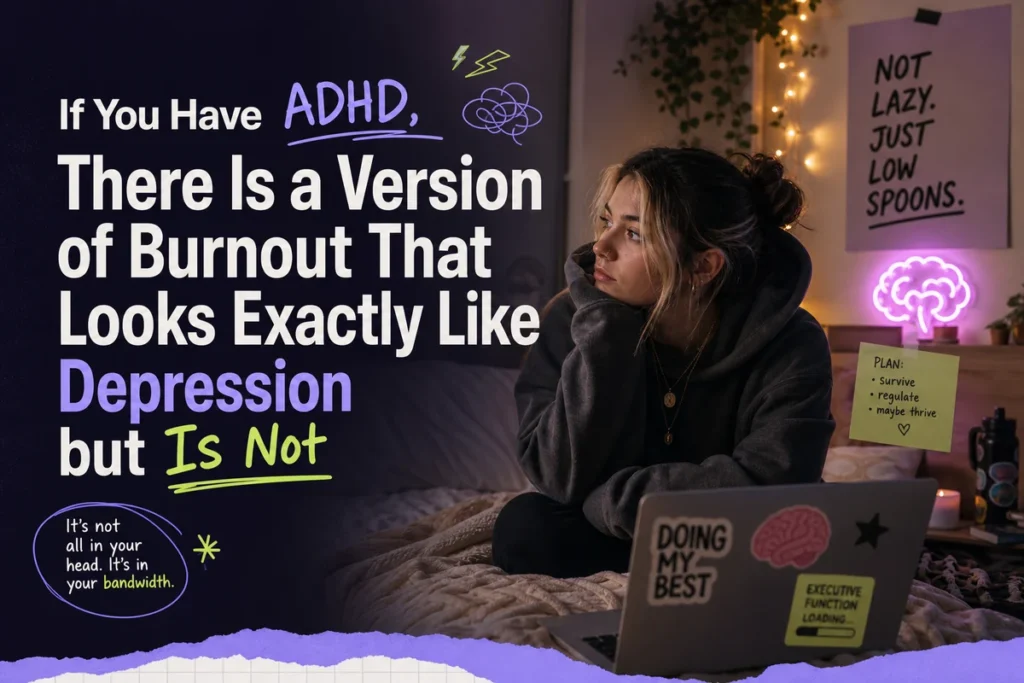
You are lying in bed scrolling through nothing. You cannot make yourself care about anything. The things that used to excite you feel distant, like they happened to someone else. You have been here before, but this time it will not lift. You wonder if you are depressed. Maybe you have always been depressed. Maybe the ADHD was a misdiagnosis and this emptiness is who you actually are.
Then your friend texts about a random hyperfixation topic. Or you stumble on a video about something genuinely interesting. And for twenty minutes, you feel like yourself again. The fog clears. Your brain turns on. You are engaged, curious, present.
Then the video ends, and the flatness comes back.
If this cycle sounds familiar, you might be dealing with ADHD burnout, not depression. And the difference between ADHD burnout vs depression is not just semantic. It changes how you recover, what treatment actually helps, and whether you keep blaming yourself for something that was never a character flaw.
The Clinical Difference Nobody Explains Clearly
Here is the distinguisher that most content glosses over or buries in jargon: ADHD burnout lifts, temporarily, when you encounter something genuinely interesting. Depression does not.
With clinical depression, anhedonia (the inability to feel pleasure) is pervasive. Even things you used to love feel empty. A friend could hand you tickets to your favorite artist, and you would feel nothing. The flatness is constant regardless of stimulus.
With ADHD burnout, the flatness is contextual. Your capacity for interest is not gone. It is just inaccessible for anything that requires effort, obligation, or sustained attention. When something genuinely captures your interest, unprompted and pressure-free, you can still feel that spark. It might only last minutes. But it is there.
This distinction matters because the treatments are different. Antidepressants that work for clinical depression might do very little for ADHD burnout. The ADHD burnout requires something else entirely: rest, reduced demands, and understanding that you are not broken. You are depleted.
What ADHD Burnout Actually Is
ADHD burnout is what happens when you run your dopamine-seeking brain on a neurotypical operating system for too long. It is the crash that comes after years of masking, compensating, and white-knuckling through tasks that cost you three times the energy they cost everyone else.
Your brain has been working overtime just to function at baseline. Every task that should be automatic requires conscious effort. Getting out of bed involves a negotiation. Answering emails requires an internal pep talk. By the time you finish a workday, you have used all your cognitive resources on things that seem simple from the outside.
This is unsustainable. And when the crash comes, it looks a lot like depression. You withdraw. You stop caring. You cannot make yourself do things. The difference is why you cannot make yourself do things.
In depression, the motivation is broken at a fundamental level. In ADHD burnout, the motivation is depleted from overuse. Your brain has been running on fumes, and now it is forcing you to stop.
Why This Gets Misdiagnosed Constantly
The symptom overlap is significant. Both involve fatigue, withdrawal, difficulty with tasks, and changes in sleep and appetite. If you go to a doctor describing these symptoms, depression is the obvious diagnosis. Especially if you are already anxious, because anxiety plus these symptoms equals depression on most screening tools.
The problem is that ADHD burnout does not appear on those screening tools. Most clinicians are not trained to ask the question that would reveal the difference: can you still feel interested in things that genuinely capture your attention, even briefly?
This leads to treatment that misses the point. You get put on SSRIs that might help with the anxiety but do not touch the core issue. You get told to exercise and practice self-care, which feels impossible because you cannot make yourself do anything. You get labeled treatment-resistant when really you are receiving the wrong treatment.
For people with late discovery ADHD, this is especially common. You might have been diagnosed with depression years ago. You might have cycled through multiple antidepressants with minimal improvement. You might have internalized the idea that you are fundamentally broken, when really your brain was screaming for recognition the whole time.
I thought I was depressed for a decade. Turns out I was burnt out from pretending to be neurotypical. The depression was real, but it was a symptom, not the cause.
The Neurotypical Performance Tax
Here is what nobody tells you about having ADHD in a neurotypical world: everything costs more. Not just the obvious stuff like focusing in meetings or completing boring tasks. The invisible stuff too. Remembering social scripts. Regulating your tone and facial expressions. Hiding your fidgeting. Pretending you were listening when your brain wandered.
Neurotypical people do not have to think about this. Their brains handle it automatically. For you, it is constant manual effort. You are essentially running two operating systems at once: your actual brain and the neurotypical simulation you perform for everyone else.
This is called masking, and it is exhausting. Research published in the journal Autism found that camouflaging behaviors are associated with increased psychological distress and decreased wellbeing.1 While that study focused on autism, the mechanism applies to ADHD masking as well. You cannot fake being neurotypical indefinitely without consequences.
The consequences look like burnout. Then they look like depression. Then they look like you just not being able to handle life, when really you have been handling twice as much as everyone else and finally hit the wall.
The Masking Debt: Every day you perform neurotypical, you accumulate a debt your brain will eventually collect. Burnout is not weakness. It is your brain foreclosing on a loan you did not know you were taking out.
How to Tell Which One You Are Dealing With
This is not a diagnostic tool. This is a framework for understanding your own experience so you can have better conversations with professionals and yourself.
Think about the last time you felt genuinely interested in something. Not obligated. Not pressured. Genuinely curious or excited. If you can identify a moment like that in the past few weeks, even if it was brief, that suggests ADHD burnout over depression.
Now think about your energy after that moment. Did engaging with the interesting thing give you energy, even temporarily? Or did it feel like going through the motions? ADHD burnout often includes what some people call interest-based arousal: your energy level is directly tied to how interesting something is. Depression flattens everything regardless of interest.
Consider the trajectory. ADHD burnout often follows a period of high demand, increased masking, or major life transitions. It builds over time and crashes suddenly. Depression can appear without an obvious trigger and tends to descend more gradually.
Finally, notice what helps, even slightly. If talking to a friend about a shared interest lifts the fog temporarily, that is information. If nothing lifts it, that is also information. Neither answer makes you more or less valid. Both are data points for understanding what you are dealing with.
Why "Just Rest" Does Not Work (At First)
The advice for burnout is usually rest. Take time off. Reduce your obligations. Practice self-care. This is technically correct and practically useless if you have ADHD.
Here is why: ADHD brains need stimulation. When you remove all demands without adding anything interesting, you do not get rest. You get understimulation, which feels like a different kind of torture. You lie in bed feeling guilty about not resting correctly. You scroll through your phone looking for something to fill the void. You end up more depleted than before.
Effective rest for ADHD burnout is not about doing nothing. It is about doing things that replenish you without costing you. Things that engage your interest without demanding performance. Things that feel like play instead of work.
This might be rewatching a comfort show for the twelfth time. Playing a video game you have already beaten. Working on a hobby project with zero stakes. The key is removing the pressure, not removing the stimulation.
Research on ADHD and recovery supports this approach. A 2021 study in Journal of Attention Disorders found that adults with ADHD benefit from recovery activities that provide cognitive engagement without high demands.2 In other words, your brain needs stimulation to rest. It is counterintuitive, but it is how your neurology works.
The Permission You Might Need
If you are reading this and recognizing yourself, here is what I want you to know: you are not depressed because you are weak. You are not burnt out because you cannot handle life. You are exhausted because you have been running a marathon that everyone else told you was a casual walk.
The flatness you feel is not evidence that you are broken. It is evidence that you pushed too hard for too long. Your brain is not failing. It is protecting you by forcing you to stop before you break something that cannot be fixed.
This does not mean depression is not also present. ADHD and depression can absolutely coexist, and burnout can trigger depressive episodes. The point is not to dismiss depression but to understand the underlying mechanism. If the root cause is ADHD burnout, treating only the depression is like putting a bandage on a broken bone. It might help with the immediate pain, but it does not address why you keep getting hurt.
I stopped asking myself why I could not just be normal. I started asking what kind of support my actual brain needs. The answer was different than anything I had tried before.
What Actually Helps
Recovery from ADHD burnout requires three things: reduced demands, increased interest, and self-compassion. None of these are quick fixes. All of them are necessary.
Reduced demands means saying no to things. It means lowering your standards temporarily. It means accepting that you will not be performing at your usual level for a while, and that this is not failure. It is healing.
Increased interest means actively seeking out things that engage your brain without depleting it. Make a list of things that have brought you joy in the past, even small things. Prioritize those. Give yourself permission to enjoy things that seem unproductive. Your brain needs play to recover.
Self-compassion means stopping the internal narrative that you are lazy, broken, or not trying hard enough. That narrative is the voice of a world that does not understand your brain. You have been trying harder than most people will ever have to try. The fact that you are burnt out is proof of how hard you have been working, not evidence that you have not worked hard enough.
Recovery Timeline: ADHD burnout does not resolve in a weekend. Expect weeks to months of reduced capacity. This is normal. Your brain accumulated this debt over years. It will not be paid off overnight.
When to Seek Professional Help
If you are having thoughts of self-harm or suicide, please reach out to a crisis line or mental health professional immediately. Burnout and depression can both become dangerous, and the distinction between them does not matter if you are in crisis.
If you are not in crisis but have been struggling for weeks without improvement, it is worth talking to someone who understands ADHD. This might be a psychiatrist, psychologist, or therapist who specializes in neurodivergent adults. Be explicit about wanting to explore the difference between ADHD burnout vs depression. Not all providers are familiar with this distinction.
If you are already on antidepressants and they do not seem to be helping, bring this up. It does not mean stopping medication without guidance. It means having a conversation about whether your current treatment is addressing the right issue.
You deserve support that actually matches your brain. Advocating for that is not being difficult. It is being accurate about what you need.
Moving Forward Without the Guilt
The hardest part of recovering from ADHD burnout is releasing the guilt. You will feel like you should be doing more. You will compare yourself to people who seem to handle everything without falling apart. You will wonder if you are using ADHD as an excuse.
You are not. Your brain works differently. Different brains require different approaches. This is not a moral issue. It is a practical one.
The goal is not to push through and get back to overperforming as quickly as possible. The goal is to build a life that does not require constant overperformance. A life with enough margin, enough accommodation, and enough self-understanding that burnout becomes the exception instead of the inevitable cycle.
That might mean career changes. It might mean relationship changes. It might mean finally getting the accommodations you have been too proud or too scared to ask for. Whatever it means for you, it starts with recognizing that you have been running a race nobody told you was a race, and you are allowed to stop.
You are not depressed because you are not trying. You are burnt out because you have been trying too hard, with too little support, for too long. And that can change.
1 Hull, L., et al. (2017). Putting on My Best Normal: Social Camouflaging in Adults with Autism Spectrum Conditions. Journal of Autism and Developmental Disorders, 47(8), 2519-2534.
2 Fuermaier, A. B. M., et al. (2021). Cognitive and psychological strategies during recovery from burnout in adults with ADHD. Journal of Attention Disorders, 25(4), 523-535.
Rate this article
Was this a useful hit?