Bed Rotting Is Not a Personality Flaw. It Might Be Your Brain Asking for Something.

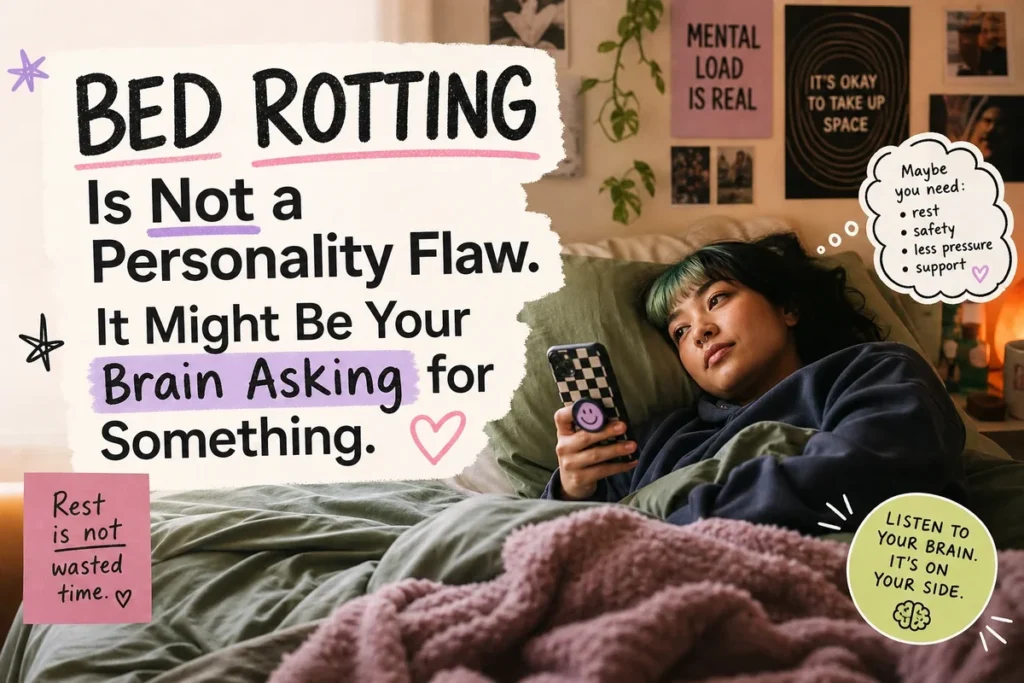
It's Sunday at 4pm and you've been in bed since Friday night. Not sick. Not hungover. Just... in bed. You've scrolled through the same three apps so many times that your thumb moves automatically, cycling TikTok to Instagram to Reddit and back without any conscious decision. You've watched the light change through your window twice now. You told yourself you'd shower "in an hour" six hours ago. The pile of laundry in the corner has been there so long it's become furniture.
And the worst part isn't being in bed. The worst part is that you cannot figure out if this is rest or if something is wrong. Everyone talks about ADHD bed rotting like it's a cute personality quirk, another relatable meme. But you're lying here wondering if you're recovering from something or hiding from everything. If your body genuinely needed this or if your brain has simply... stopped.
You're not alone in this specific confusion. And the answer is more complicated than "just get up" or "rest is valid." Both of those can be true, and neither is useful when you can't tell which one applies to you right now.
What ADHD Bed Rotting Actually Is (And Isn't)
Let's be clear about something first: bed rotting as a concept isn't new. People have been lying in bed for extended periods since beds existed. What's new is the name, the normalization, and the very specific way it shows up in ADHD brains.
For neurotypical people, bed rotting is usually a choice. A deliberate decompression. They spend a lazy Sunday in bed, feel restored, and move on with their week. The rest has a beginning, a middle, and an end. It refills something.
ADHD bed rotting often doesn't work that way. It's less "I'm choosing to rest" and more "I cannot seem to generate the activation energy required to exist vertically." The distinction matters because it changes what you need to do about it. One is recovery. The other is a symptom.
Research on ADHD and fatigue shows that our brains use more energy to accomplish baseline tasks than neurotypical brains do.1 The constant effort of executive function, the work of filtering stimuli, the energy drain of masking in public: all of this creates a legitimate deficit. Your body isn't lying when it says it's tired. You probably are tired. The question is whether lying in bed is addressing that tiredness or avoiding something else entirely.
The Difference Between Rest and Shutdown
Here's a framework that might help. Think of two types of horizontal time:
Genuine rest feels like slowly refilling. You might not want to get up, but you feel marginally better as time passes. Your thoughts aren't spiraling. You're not avoiding anything specific; you're just... existing. After a few hours, you might naturally feel the urge to shower, eat something real, or text someone back. The rest has an organic end point.
Burnout shutdown feels like sinking. Hours pass and you feel the same or worse. Your mind loops on everything you're not doing. Getting up feels not just difficult but terrifying, like if you stand you'll have to face something you cannot handle. The thought of food makes you tired. The thought of showering makes you tired. The thought of thinking makes you tired.
Burnout shutdown often comes with a specific flavor of paralysis: you're exhausted but not sleepy. You want to rest but can't actually relax. Your body is still but your nervous system is screaming.
If you've been in bed all weekend and you feel worse now than you did Friday night, that's information. Not a judgment. Information.
Why Your Brain Goes Here (The Neuroscience Version)
Understanding why this happens doesn't fix it, but it does help you stop interpreting it as a character flaw.
ADHD brains have lower baseline dopamine activity. This means the reward system that motivates neurotypical people to get up, eat breakfast, and shower doesn't fire as reliably for you. When you're depleted, this system can essentially go offline. The things that normally generate even a tiny spark of motivation: coffee, sunshine, the promise of breakfast: they just... don't register.
Add to this the ADHD tendency toward interest-based motivation rather than importance-based motivation. A neurotypical person might get up because they "should." Your brain doesn't respond to should. It responds to want, need, or fear. When you're burned out, you don't want to do anything. You don't immediately need to do anything. And you're too tired to feel fear about consequences. So you stay in bed.
Neurodivergent bed rotting is also connected to something called dorsal attention network deactivation, which is the brain's way of saying "I'm done processing external input right now." When this network gets overloaded, your brain literally reduces your ability to engage with the outside world. It's not that you won't get up. It's that the neural pathway to external engagement has been throttled.
This is why telling yourself to "just get up" doesn't work. You're trying to use a system that's currently offline.
ADHD Bed Rotting: The Uncomfortable Questions
Here's where we have to get honest. Some questions to ask yourself when you've been horizontal for a while:
When did this start? If you've been increasingly bed-bound over weeks or months, that's different from a single weekend of collapse. Gradual escalation often points to burnout, depression, or unaddressed overwhelm, not just needing rest.
What happened before this? Sometimes we can trace bed rotting to a specific event: a brutal week at work, a social situation that drained you, a conflict, a rejection. If you can identify the trigger, you can start to address it. If you can't identify anything, that's worth noticing too.
Are you avoiding something specific? This is hard to answer honestly. Sometimes bed rotting is a protection mechanism. Your brain knows there's something overwhelming waiting for you: emails, conversations, decisions: and it's keeping you down to avoid it. The avoidance feels like rest but it carries a specific dread underneath.
Does anything sound good? Not "would you be willing to do X" but "does anything actually sound appealing?" If the answer is genuinely no, nothing at all, that's a depression flag. If the answer is "yes, but I can't make myself do it," that's executive dysfunction. Different problems, different solutions.
Not a test: These questions aren't meant to make you feel guilty. They're meant to help you understand what you're dealing with. Knowing you're in shutdown is actually useful information because it tells you that rest alone won't fix this.
When Bed Rot Is Actually Necessary
Let's be clear: sometimes staying in bed for two days is exactly what you need. Gen Z burnout rest is real and necessary. You live in a world that demands constant productivity, constant availability, constant performance. Your nervous system was not designed for this.
ADHD brains are particularly vulnerable to overstimulation and energy depletion. If you've been masking at work all week, socializing through the weekend, and never actually dropping into genuine rest, your body might just... take it. Involuntarily. Without asking your permission or checking your calendar.
Bed rotting as genuine rest usually has these qualities:
You feel safe. Not happy necessarily, but safe. The absence of demands feels like relief rather than avoidance.
Time passes without spiraling thoughts. You're not lying there cataloging everything wrong with you or everything you should be doing. You're just... existing.
Your body actually relaxes. Your jaw unclenches. Your shoulders drop. Sleep comes relatively easily if you want it.
You emerge feeling somewhat restored. Not perfect, not energized, but not worse. Maybe even slightly better.
If this describes your experience, you might actually just need rest. Real rest. The kind that our productivity-obsessed culture tells us is laziness but is actually essential maintenance.
When It's Something Else
But here's the harder truth: ADHD bed rot symptom can also be your brain's way of signaling that something is seriously wrong. Depression in ADHD often looks different than textbook depression. It can show up as complete inability to initiate any task, even things you want to do. It can look like bed rotting that stretches from days into weeks.
ADHD burnout specifically creates a kind of paralysis that's hard to distinguish from rest. You're not sad necessarily. You're not even always tired. You're just... unable. The activation energy required to do anything feels like more than you have.
Signs that your bed rotting might need more than rest:
It's been going on for more than a few days and isn't improving.
You feel worse as time passes, not better.
Basic hygiene feels impossible, not just unappealing.
You're having thoughts about not existing, not wanting to be here, or feeling like a burden.
You can't remember the last time anything felt good.
None of these mean you're broken. All of them mean you might need more support than a weekend in bed can provide.
Your brain asking for help by making you unable to function is still your brain asking for help. The message is just coming through a difficult channel.
What To Do When You Can't Tell
Most of us exist in the confusing middle ground. You're not actively suicidal but you're not okay. You've been in bed for a while but you're not sure if it's been too long. Here's what might help:
Add one sensory input. Open the blinds. Turn on a lamp. Put on a podcast or familiar TV show, something you've heard before so it doesn't require active attention. You're not trying to "fix" anything. You're just giving your nervous system something other than darkness and your own thoughts.
Eat something, anything. This isn't about nutrition right now. It's about telling your body that you're still taking care of it. A handful of crackers. A protein bar. Whatever is easiest. Your brain runs on glucose. It's hard to assess anything accurately when you're running on empty.
Send one message. Text someone who knows you. It doesn't have to explain anything. "Hey, I've been having a hard time" is enough. You're not asking them to fix it. You're just creating a tiny thread of connection outside your bed.
Notice what happens at the 24-hour mark. Set a mental checkpoint. If you're still in bed in 24 hours and feel the same or worse, that's useful information. It suggests you need more than rest.
Regulation matters: Sometimes the issue isn't that you need rest or that you need to get up. It's that your nervous system has lost its ability to regulate at all. You're stuck between activation states, too wired to relax and too depleted to function. When this happens, tiny regulation practices matter more than big decisions. Try Steady for some guided options.
The Permission You're Not Looking For
Here's what I'm not going to tell you: whether you should stay in bed or get up. I don't know your situation. I don't know what happened this week. I don't know if you're recovering from years of masking or hiding from a specific email you're terrified to open.
What I can tell you is that bed rotting as an ADHD person is not a moral failing. It's not laziness. It's not evidence that you're bad at being an adult. It's a symptom, and symptoms carry information.
If your bed rotting feels like restoration, trust it. Your brain might genuinely need the break.
If your bed rotting feels like quicksand, trust that too. You might need something that rest can't provide, whether that's support from another person, professional help, or just the small first step of standing up and opening a window.
You are not the only person lying in bed on a Sunday wondering if this is self-care or self-destruction. That question is one of the most common experiences ADHD people share. The fact that you're asking it means you're still paying attention to yourself. That counts for something.
ADHD bed rotting will probably happen again. It's part of how this brain works. But each time it happens, you get slightly better at reading what your body is actually asking for. And that skill, the ability to tell the difference between rest and shutdown, is one of the most useful things you can develop.
For now, just notice. Don't judge. Notice. The answer will get clearer.
1 Wiersema, J. R., & Roeyers, H. (2009). The role of fatigue and vigilance in attention-deficit/hyperactivity disorder: A review of the literature. Clinical Neuropsychiatry, 6(1), 19-26.
Rate this article
Was this a useful hit?