Your Brain Won't Shut Off at Night. Here's Why

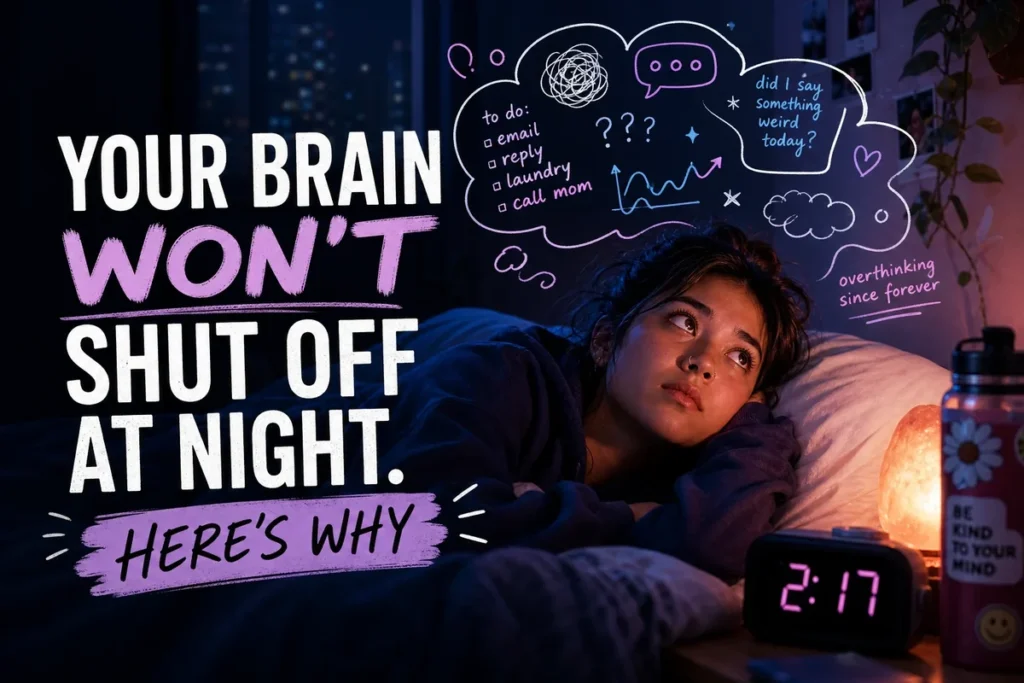
It's 2:47am. You have work in five hours. Your body is exhausted, the kind of tired that sits behind your eyes like sand. And your brain? Your brain has decided this is the perfect moment to remember that weird thing you said to a coworker in 2021. Then it pivots to wondering if you turned off the stove. Then it starts composing a reply to an email you haven't received yet. Then it's suddenly fascinated by whether penguins have knees.
You're not lazy. You're not bad at sleep. You're experiencing one of the most common and least talked about aspects of ADHD sleep problems: the brain that absolutely refuses to power down.
And here's what makes it worse: everyone's advice is useless. "Just go to bed earlier." "Put your phone away." "Try chamomile tea." You've tried it. It doesn't work. Because the problem isn't your bedtime routine. The problem is that your brain is running on a completely different operating system than the advice-givers assume.
ADHD Sleep Problems Aren't About Discipline
Let's get something straight. When neurotypical people talk about sleep, they're describing a system where tiredness leads to sleepiness leads to sleep. Input, output. Simple.
Your system doesn't work like that. Research shows that up to 75% of adults with ADHD report significant sleep difficulties.1 This isn't a coincidence or a collection of individual failures. This is a pattern. A feature, not a bug.
ADHD sleep problems stem from three overlapping neurological realities that nobody explained to you:
Your circadian rhythm is shifted. Studies consistently show that people with ADHD tend to have a delayed circadian rhythm, meaning your body's internal clock runs on a later schedule than society demands.2 Your melatonin release happens later. Your natural sleep window is later. That 11pm bedtime everyone recommends? Your brain hasn't even started its wind-down process yet.
Your brain struggles to disengage. The ADHD brain has trouble transitioning between states. The same difficulty you have switching tasks during the day, moving from one project to another without getting stuck? That applies to the transition from "awake" to "asleep." Your brain doesn't release attention easily. It holds on.
Your dopamine system doesn't quit. At night, neurotypical brains start reducing dopamine activity as part of the sleep preparation process. Your brain, already running on a dopamine deficit, keeps hunting for stimulation. That's why you suddenly find everything interesting at midnight. Your brain is desperately seeking the engagement it's been chasing all day.
The 47 Browser Tabs Problem
Imagine trying to shut down a computer that has 47 browser tabs open, three software updates pending, a download running, and a video playing in some minimized window you can't find. That's your brain at bedtime.
The tabs are thoughts. The updates are unfinished tasks nagging at you. The download is that conversation you need to process. The hidden video is the low-level anxiety soundtrack that's been playing all day.
Neurotypical brains have a relatively automatic process for closing these tabs. As they get tired, thoughts naturally become less sticky, less demanding. The brain files things away for tomorrow without being asked.
Your brain doesn't do that. Every tab stays open. Every thought demands equal attention. The concept of "I'll think about that tomorrow" feels like a lie because your brain doesn't believe tomorrow exists with the same urgency as right now.
The ADHD brain at night is not failing to sleep. It's succeeding at staying engaged with its thoughts. That's what it's built to do.
This is why "just relax" is such insulting advice. You can't relax because relaxation requires disengagement, and disengagement is exactly what your neurology struggles with most.
Why Racing Thoughts Get Worse at Night
During the day, you have external structure. Work demands. Social interactions. Environmental noise. Your brain has things to bounce off of, ways to distribute its attention across multiple real-world inputs.
At night, all of that disappears. It's just you and your brain in a dark room with nothing to look at. For a brain that requires external stimulation to regulate itself, this is a nightmare scenario. Literally.
ADHD racing thoughts at night aren't random. They follow a predictable pattern:
Your brain seeks stimulation. Without external input, it generates internal input. Thoughts. Memories. Projections. Worries. Anything to stay active.
Negative thoughts are stickier. Your brain prioritizes emotionally charged content because it's more stimulating. That's why you don't lie awake thinking about pleasant neutral memories. You lie awake thinking about embarrassing moments, conflicts, fears.
The stakes feel higher. At night, with nothing to distract you, thoughts that would be manageable during the day become overwhelming. That slightly awkward interaction? At 2am, it's a catastrophe. Your brain has nothing else to compare it to, so it takes up the whole screen.
The quiet room paradox: Your brain needs stimulation to calm down. Silence isn't peaceful for ADHD brains. It's a void that demands to be filled. This is why many people with ADHD actually sleep better with background noise, podcasts, or TV than in complete silence.
The Revenge Bedtime Procrastination Trap
There's another layer to ADHD sleep problems that rarely gets named: you don't want to go to sleep because sleep feels like losing.
All day, you've been doing what others expect. Working, responding, managing, masking. By the time evening comes, those late night hours feel like the only time that's actually yours. The only time nobody needs anything from you. The only time you can exist without demands.
So you stay up. Not because you're not tired, but because going to sleep means giving up your only free time. It means tomorrow comes faster. It means the cycle starts again without you ever getting a moment to just exist.
This is called revenge bedtime procrastination, and it hits people with ADHD especially hard because:
Your sense of time is already distorted. "Just 20 more minutes" genuinely feels like 20 minutes even when it's been two hours. The time blindness that makes you late to everything also makes you late to bed.
You're more likely to hyperfocus at night. With no interruptions, no demands, your brain can finally sink into something. Video games, scrolling, reading, creating. The hyperfocus that eluded you all day suddenly clicks in at midnight.
Transitions are hard. Getting into bed requires stopping what you're doing, physically moving, changing clothes, doing the whole routine. Every step is a small wall. The activation energy required feels enormous when you're already depleted.
You're not staying up because you're irresponsible. You're staying up because your nervous system is finally unregulated enough to feel like itself, and that feeling is addictive when you've been suppressing it all day.
What Actually Helps When Generic Sleep Hygiene Fails
Standard sleep advice assumes a neurotypical brain. Blue light blocking glasses aren't useless, but they're not addressing the core problem. Here's what actually targets ADHD-specific sleep struggles.
Give your brain something boring to do. Not nothing. Something. The ADHD brain cannot idle. Instead of fighting this, work with it. Boring podcasts, sleep stories, familiar TV shows you've seen a hundred times. Give your brain low-stakes stimulation so it doesn't generate high-stakes thoughts.
Externalize your thoughts. Keep a notepad or voice memo app by your bed. When a thought keeps circling, capture it externally. Write it down or record it. Tell your brain explicitly: "This is saved. We can address it tomorrow." Your brain won't trust this at first, but repetition builds the trust.
Create transition rituals with sensory components. Generic advice says "have a routine." ADHD brains need specificity. What works is a physical, sensory sequence that your body starts to associate with sleep. A specific scent. A specific playlist. A specific sequence of actions. Make it the same every night until your nervous system learns: these sensations mean we're winding down.
Consider your chronotype. If your natural sleep window is 1am to 9am, fighting that with a 10pm bedtime creates nightly failure. Where possible, adjust your schedule to match your biology rather than forcing your biology to match the schedule. This isn't always possible, but when it is, it's transformative.
Address the body, not just the mind. ADHD insomnia often has a physical restlessness component. Progressive muscle relaxation, weighted blankets, body scanning. These give your brain something to focus on while also releasing physical tension that's keeping you activated.
The Medication Question
ADHD medication and sleep have a complicated relationship that varies dramatically by person.
Some people find that stimulant medication actually helps them sleep because their brain is finally regulated enough to disengage. The daytime chaos is managed, so nighttime isn't playing catch-up with unprocessed everything.
Others find that medication, especially if taken too late in the day, keeps them wired. The timing matters enormously. If you're on medication and struggling with sleep, tracking when you take it versus when you can't sleep often reveals patterns.
There are also non-stimulant options and supplementary medications specifically for ADHD-related sleep issues. This is absolutely a conversation to have with whoever prescribes your medication, with specific details about what your sleep problem actually looks like.
Melatonin reality check: Over-the-counter melatonin dosing is often way too high. Research suggests 0.5mg to 1mg is actually more effective than the 5mg or 10mg doses commonly sold.3 More isn't better. And timing matters more than dose. Taking it 2 to 3 hours before desired sleep, not at bedtime, gives it time to shift your rhythm.
The Shame Spiral and How to Interrupt It
Here's the part nobody talks about: ADHD sleep problems create a shame spiral that makes everything worse.
You can't sleep. So you're tired. So you can't function well. So you feel bad about yourself. So you're stressed. So you can't sleep. Repeat.
The tiredness makes every ADHD symptom worse. Executive function, emotional regulation, attention, memory. All of it degrades with sleep deprivation. Which makes you feel more broken. Which makes nighttime feel more fraught with the weight of "I need to sleep so I can function tomorrow."
That pressure is counterproductive. You cannot pressure yourself to sleep. It doesn't work that way. The more you need to sleep, the harder sleep becomes because your brain is now activated by the stakes.
Interrupting this spiral means accepting some uncomfortable truths:
One bad night won't destroy you. Yes, you'll be tired. Yes, it'll be hard. But catastrophizing about lack of sleep keeps you awake longer than the lack of sleep itself will impair you.
Rest has value even without sleep. Lying in bed with your eyes closed, even if you're not sleeping, provides some physical recovery. It's not nothing. Telling yourself "at least I'm resting" is more useful than "I'm failing at sleeping."
Your sleep problems are medical, not moral. You didn't choose this brain. You're not weak. You're working with a nervous system that operates on different rules, and nobody gave you the manual.
Building a System That Works With Your Brain
The goal isn't to become a perfect sleeper. It's to build a sustainable system that accounts for how your brain actually works.
This means:
Having multiple tools, not just one strategy. Some nights the podcast works. Some nights you need the notepad. Some nights you need to get up and do something boring until you're actually tired. Flexibility isn't failure.
Tracking what works and what doesn't. Not obsessively, but enough to notice patterns. Which nights are harder? What happened that day? What did you eat, when did you take medication, what was your stress level? Data helps you adjust.
Being compassionate when it doesn't work. You're going to have bad nights. That's part of having this brain. What matters is returning to your system the next night without carrying judgment forward.
Asking for accommodations where possible. Flexible work start times, understanding partners, structures that don't require you to perform at 8am when your brain didn't fall asleep until 3am. Accommodations aren't cheating. They're equalizing.
Your brain will never operate on the schedule the world designed around neurotypical sleep patterns. That's not failure. That's neurology. Your job is to find the workarounds that let you function anyway.
ADHD sleep problems are real. They're documented. They're neurological. And they're manageable, not through willpower or discipline, but through understanding what your brain actually needs and building systems that provide it. The racing thoughts, the revenge procrastination, the inability to disengage: these are symptoms of a brain that works differently, not evidence of personal failure. Stop trying to sleep like a neurotypical. Start learning to sleep like yourself.
1 Surman, C. B., & Walsh, D. M. (2021). Managing sleep disturbances in adults with ADHD. CNS Drugs, 35(4), 345-356.
2 Coogan, A. N., & McGowan, N. M. (2017). A systematic review of circadian function, chronotype and chronotherapy in attention deficit hyperactivity disorder. ADHD Attention Deficit and Hyperactivity Disorders, 9(3), 129-147.
3 Erland, L. A., & Bhardwaj, A. K. (2016). Melatonin natural health products and supplements. Clinical Journal of Sport Medicine, 26(5), 450-451.
Rate this article
Was this a useful hit?