You Spent 45 Minutes Deciding What to Eat and Then Just Did Not Eat

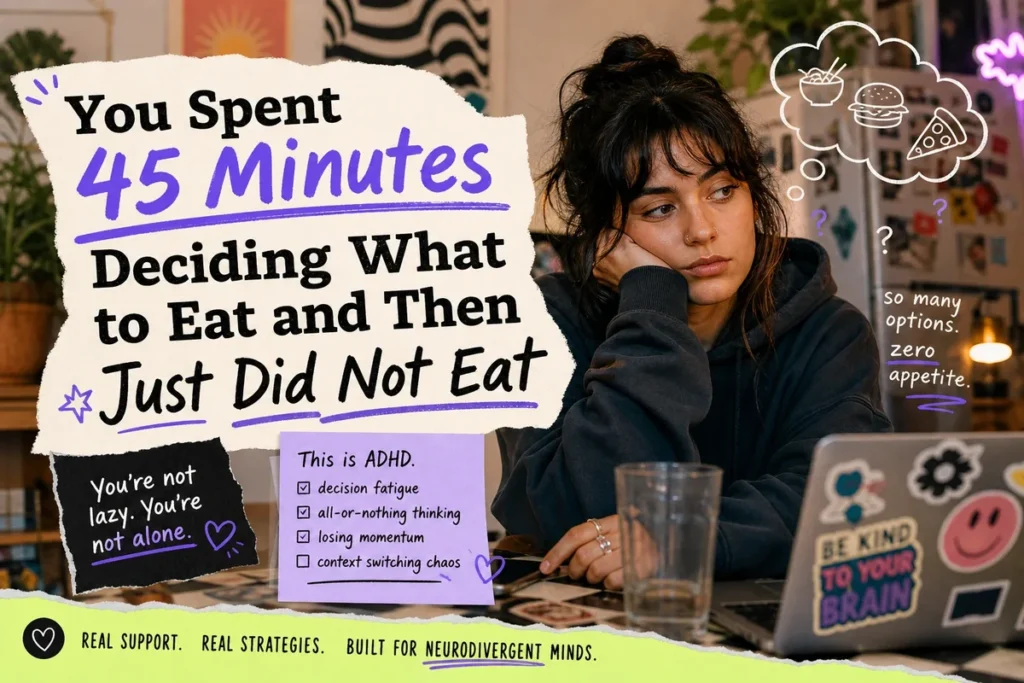
You opened Uber Eats thirty minutes ago. You have scrolled past Thai food four times. You briefly considered sushi, then remembered you had sushi last week, then questioned whether that even matters, then opened a new tab to check your bank account, then forgot what you were doing, then came back to Uber Eats and started the scroll again. Now you are not even hungry anymore. You close the app. You eat nothing. You feel like a failure for not being able to complete the simple human task of feeding yourself.
This is ADHD analysis paralysis. And if you have lived it, you already know it is not about the food.
ADHD Analysis Paralysis Is Not Indecision
Let's be clear about what this is and what it is not. ADHD analysis paralysis is not being a picky eater. It is not being high-maintenance. It is not overthinking because you are dramatic. It is your brain's executive function system grinding to a halt when faced with too many options and not enough internal structure to navigate them.
Neurotypical brains have a built-in prioritization system. When they see a menu with 47 items, something in their prefrontal cortex goes: "I had chicken yesterday, I'm craving something warm, that pasta looks good, done." The whole process takes maybe ninety seconds. They do not experience it as a process at all. It just happens.
Your brain does not do that. Your brain sees 47 items and treats each one as equally possible, equally requiring evaluation, equally demanding your attention. There is no automatic filter saying "these 40 options are irrelevant to you right now." Every single choice stays active. Every single choice wants to be considered. And your working memory, which is supposed to hold your preferences and constraints while you compare options, keeps dropping information. So you scroll back up to check what the Thai place had, and by the time you find it, you have forgotten why you were checking.
This is not a personality flaw. This is a brain difference. And it happens with everything.
The Specific Hell of Small Decisions
Here is what neurotypical people do not understand: big decisions are often easier for us than small ones.
Choosing a career, picking a city to move to, deciding whether to end a relationship: these come with external stakes. Other people have opinions. There are clear consequences. The weight of the decision generates its own momentum. Your brain recognizes this as Important and sometimes, miraculously, shows up.
But what to eat for lunch? What to wear today? Which email to answer first? Which YouTube video to watch during your break? There are no stakes. There is no deadline. No one is going to check your work. And without external structure, your brain cannot generate internal structure. So you stand in front of your closet for twenty minutes, picking up shirts and putting them down, while your anxiety slowly rises because you know this should not be hard and yet here you are, stuck.
ADHD decision fatigue hits hardest on the things that should be easiest. The lower the stakes, the longer you stall.
This is because decisions, all decisions, require executive function. They require your brain to hold multiple options in mind, compare them against your values and preferences, predict future outcomes, and commit to one path while releasing the others. Every single decision you make, from "should I check this notification" to "what career should I pursue," draws from the same limited pool of cognitive resources.
And your pool is smaller than most. Not because you are broken, but because ADHD brains have a different relationship with the neurochemistry that powers this whole system.
Why Your Brain Stalls: The Actual Mechanism
Dopamine is not a reward chemical. That is a simplification that has gotten wildly out of hand. Dopamine is a motivation chemical, a salience chemical, a "this matters, pay attention" chemical. It is what tells your brain which option to prioritize when everything looks equal.
In ADHD, dopamine signaling works differently. The research is still evolving, but we know that ADHD brains often have lower baseline dopamine activity and differences in dopamine receptor density.1 This means your brain is constantly searching for signals about what matters, and often not finding them.
When a neurotypical person looks at a menu, their dopamine system goes: "Oh, that pasta, yes, that one." A small spike of interest that narrows the field. Your brain looks at the same menu and gets... static. Everything is equally interesting or equally uninteresting. Nothing stands out. So you keep scrolling, hoping something will finally light up, and it never does.
This is not a willpower problem. You cannot force your brain to find something interesting when the dopamine signal is not there. You can only work with the system you have.
The scroll is a search for signal: When you cycle through options without deciding, you are not procrastinating. Your brain is literally looking for the dopamine spike that would tell it "this one." The spike is not coming. Knowing this is the first step to working around it.
ADHD Analysis Paralysis and the Perfectionism Trap
There is another layer to this, and it is sneakier. Many ADHDers develop perfectionism as a coping mechanism. Years of getting things wrong, of making impulsive choices and regretting them, of being told you should have thought more carefully: these experiences leave a residue. So now part of your brain believes that if you just analyze enough, you will find the perfect choice. The one you will not regret. The one that proves you are capable of making good decisions after all.
This is a trap. There is no perfect choice. There is no amount of analysis that will guarantee you will not regret your decision later. And the pursuit of perfect keeps you stuck in the scroll, burning through your limited executive function resources, getting more exhausted and less capable of deciding with every passing minute.
The research on decision fatigue shows that decision quality degrades as you make more choices throughout the day.2 But for ADHDers, the degradation starts earlier and hits harder. By the time you have gotten through your morning routine, answered some texts, figured out which tasks to work on, and handled a few small work decisions, you may have already depleted the resources you needed to decide what to have for lunch.
And then you stand in front of the fridge, staring, while your brain offers you nothing but static.
What Does Not Help (And Why People Keep Suggesting It)
Let's address the advice you have probably already received:
"Just pick something." Cool. The problem is that "just picking" requires the exact executive function capacity that is currently offline. This advice assumes you have access to a brain state you do not have access to. It is like telling someone with a broken leg to just walk it off.
"Make a pros and cons list." This can sometimes help with big decisions, but for small ones, it makes things worse. Now you are not just trying to decide between pasta and sushi. You are trying to decide, then write it down, then evaluate each point, then weigh them against each other. You have added four more decision points to the original decision. Your brain is now even more overwhelmed.
"Stop overthinking." This is not overthinking. Overthinking implies there is a thinking process happening that you could choose to stop. ADHD analysis paralysis is closer to a system freeze. The thoughts are not excessive, they are stuck. They are looping, not progressing. Telling someone to stop looping is like telling a buffering video to stop buffering. The issue is not effort. The issue is capacity.
"You're making it harder than it needs to be." Maybe. But not on purpose. And saying this does not help anyone make it easier.
What Actually Helps When ADHD Means You Can't Make Decisions
The goal is not to get better at deciding. The goal is to need fewer decisions.
Reduce the options before the moment arrives. Meal prep on Sunday does not just save time. It removes five dinners' worth of decisions from your week. Laying out clothes the night before means morning-you does not have to access executive function that morning-you does not have. Setting up your three tasks for the next day means tomorrow-you already knows what to start with.
This is not about discipline. It is about understanding that your future self will not have more capacity than your current self, and building systems that account for that reality.
Create arbitrary constraints. Your brain cannot decide between 47 options? Remove 44 of them. Only look at the first three restaurants. Only consider clothes that are already clean and visible. Only choose from tasks that take under ten minutes. The constraints are arbitrary, yes, but arbitrary constraints still narrow the field. And a narrow field is one your brain might actually be able to process.
Embrace "good enough" as a strategy. This is hard, especially if perfectionism has become part of your coping. But here is the truth: a mediocre lunch that you actually eat is infinitely better than a perfect dinner you never order. A semi-appropriate outfit that you put on is better than the perfect outfit you never chose. Good enough, when you are experiencing ADHD decision fatigue, is a radical act.
Use external randomizers. Seriously. Roll a die. Use a random number generator. Ask someone else to pick. When your internal prioritization system is offline, borrowing an external one is not cheating. It is adaptation.
When you can't decide, you are not failing at something easy. You are hitting a wall your brain builds automatically. The answer is not to push harder. It is to find a different path.
The Accumulation Problem and ADHD Decision Fatigue
One more thing that people do not talk about enough: decisions accumulate.
You wake up. Do you check your phone or not? (Decision.) What app do you open first? (Decision.) Do you respond to that text now or later? (Decision.) Do you get up or scroll for another five minutes? (Decision.) What do you eat for breakfast? (Decision.) Do you shower first or eat first? (Decision.) What do you wear? (Decision.) Do you take the usual route or try a different one? (Decision.)
You have not even gotten to work yet. You have already made more decisions than you might consciously realize, and each one, no matter how small, has pulled from the same limited tank. By noon, you are running on empty. By 5pm, you are asking someone else to just tell you what to do because you cannot handle one more choice.
This is why ADHD decision fatigue feels especially brutal for people who live alone or work independently. There is no one to outsource decisions to. Every single choice falls on you. And the weight of that, over time, is exhausting in a way that is hard to explain to someone who has never experienced it.
Understanding this pattern is useful. You are not getting worse at decisions as the day goes on because you are weak or lazy. You are depleting a finite resource that replenishes with rest. Planning your hardest decisions for earlier in the day, protecting your mornings from unnecessary choices, and building in decision-free blocks are not hacks. They are accommodations for a real neurological difference.
When the Freeze Happens Anyway
You will still get stuck sometimes. All the preparation in the world will not prevent every freeze. So what do you do when you are already in it, already scrolling, already standing in front of the closet with your brain offering nothing but static?
First: recognize it. Name it out loud if that helps. "This is ADHD analysis paralysis. My brain is stuck." Recognition interrupts the loop, even if only slightly. It shifts you from "I am failing at a simple task" to "I am experiencing a known brain pattern."
Second: set a constraint. Any constraint. "I am going to set a timer for two minutes and pick whatever I am looking at when it goes off." "I am going to close this app and eat whatever is already in my kitchen." "I am going to pick the first shirt my hand touches." The constraint does not have to be smart. It has to exist.
Third: accept a bad choice. This is the hardest one. The perfectionism will scream. The fear of regret will spike. But here is the reality: the cost of not choosing, of staying stuck in the scroll, is almost always higher than the cost of a mediocre choice. Eating a disappointing sandwich is better than eating nothing. Wearing a boring outfit is better than being late because you could not decide. Mediocre completion beats perfect paralysis every time.
Try Spark: When task initiation feels impossible, external scaffolding can help your brain find traction. Spark is designed to break the freeze and get you moving when your internal prioritization system is offline.
This Is Not About Willpower
If you have read this far, you probably needed someone to say this: the fact that you struggle with small decisions does not mean you are bad at being an adult. It does not mean you are dramatic, high-maintenance, or making things harder than they need to be.
ADHD analysis paralysis is a predictable outcome of the way your brain processes options, allocates attention, and generates motivation. It is not a character flaw. It is not a choice. And while understanding it does not make it go away, it does let you stop blaming yourself for something that was never about effort.
Your brain treats every decision like a test with no right answer. The solution is not to get better at the test. The solution is to need to take fewer tests, to borrow other people's answers when you can, and to accept that "probably fine" is a valid grade when you are already exhausted.
You are not broken. Your brain just needs more scaffolding around decisions than most people realize. And building that scaffolding, reducing options, creating defaults, accepting good enough, is not a failure. It is exactly what adaptation looks like when you have ADHD analysis paralysis and need to make it through the day without ending up hungry at 10pm because you never managed to pick dinner.
The scroll is not your enemy. The lack of signal is. So stop waiting for your brain to light up on the perfect choice, and start building systems that work without that signal. That is how you actually move forward.
1 Volkow, N. D., et al. (2009). Evaluating dopamine reward pathway in ADHD. JAMA, 302(10), 1084-1091.
2 Baumeister, R. F., et al. (2008). Free will in consumer behavior: Self-control, ego depletion, and choice. Journal of Consumer Psychology, 18(4), 265-276.
Rate this article
Was this a useful hit?