Drinking More Than Your Friends and Blaming Your Personality

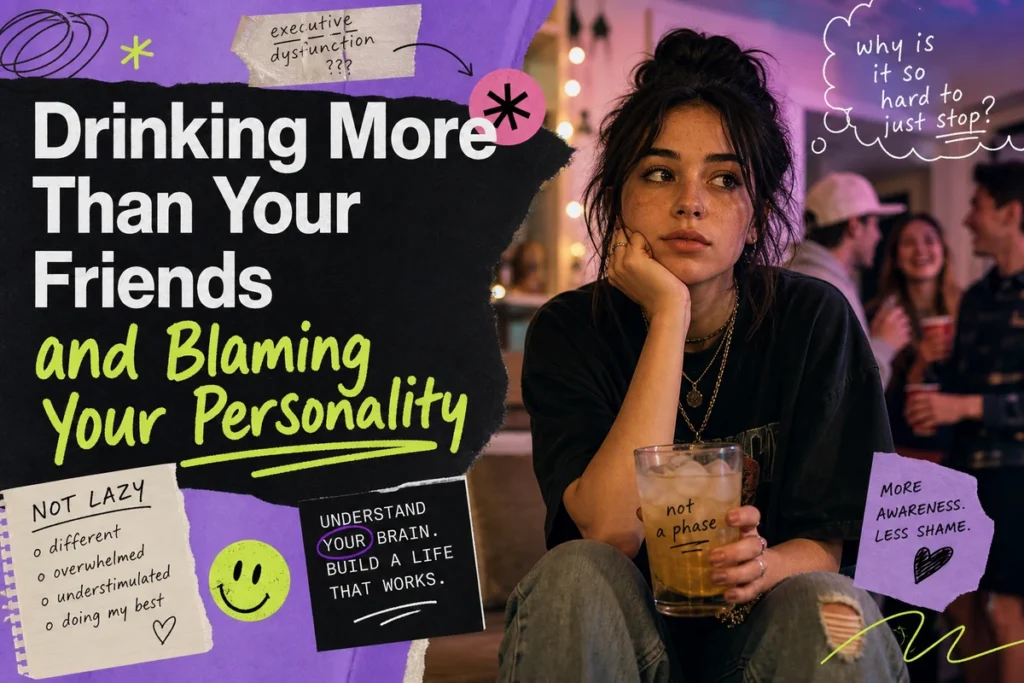
You're three drinks in and everyone else is switching to water. They're laughing, checking the time, talking about getting food. And something in your chest says: one more. Not because you're having more fun than them. Because your brain just got to the place where it finally feels quiet, and the thought of losing that is unbearable.
So you order another round. You make it a joke. You're "the party friend," the one who can hold their liquor, the one who keeps the night going. And maybe you've started to notice that this happens a lot. That you drink faster, drink more, drink past the point where other people seem satisfied. That you wake up Sunday wondering why you can't just be normal about this.
Here's the thing nobody tells you about ADHD alcohol use college: it's not about willpower. It's not about your personality. It's about a brain that's been running on empty for years, and a substance that finally makes it shut up.
Your Brain Has Been Self-Medicating Since Before You Knew
The ADHD brain is chronically understimulated. Not in the way people think, where you need constant excitement. In the way where your baseline dopamine levels are lower than neurotypical brains, and your reward system doesn't respond normally to everyday satisfactions. That finish-line feeling when you complete a task? Muted. The contentment after a good meal? Barely registers. The calm that's supposed to come from just existing? You've never felt it.
So your brain learns to chase. It chases novelty, drama, risk, intensity. Anything that spikes dopamine enough to feel like something. And alcohol? Alcohol floods your reward system with exactly what it's been starving for.
This isn't a moral failing. It's neurochemistry. Dr. Edward Khantzian's self-medication hypothesis, established in 1997, found that people with untreated psychiatric conditions often gravitate toward substances that specifically target their symptoms. Stimulant users often have underlying attention deficits. Depressant users often have underlying anxiety or emotional dysregulation. Your brain isn't broken for wanting alcohol. It's trying to fix itself with the tools available.
The problem is that alcohol is a terrible long-term solution. It borrows dopamine from tomorrow to pay for tonight. And for ADHD brains, that debt compounds faster than you'd think.
Why ADHD Alcohol Use Looks Different From Everyone Else's
Neurotypical people drink to enhance an already-okay experience. They're loose, happy, social. The alcohol adds a glow to something that was already fine.
You drink to get to okay. You drink to turn down the volume on the seventeen thoughts competing for attention. You drink to feel like you can actually be present in the conversation instead of monitoring yourself from three feet away. You drink because sober-you is exhausting, and drunk-you finally gets to rest.
This is why your relationship with alcohol feels different even when you can't explain how. You're not drinking for the same reasons. You're not getting the same thing out of it. And that's why you don't stop when they stop. They've reached "fun." You've reached "functional." Those are very different finish lines.
The difference between drinking to celebrate and drinking to cope is that one has a natural endpoint. The other doesn't.
Research published in 2022 through EurekAlert found that approximately 50 percent of adults aged 20 to 39 with ADHD have experienced a substance use disorder at some point in their lives. That's not a coincidence. That's a pattern, and you're not imagining that you're in it.
The Things You Tell Yourself About Your Drinking
You've probably already built a narrative around this. Humans are storytelling animals, and the story you tell yourself about your drinking matters because it determines whether you'll ever actually look at it.
Story one: "I just like to party." You're young. This is what people do. College is supposed to be messy. You'll grow out of it. Except you've noticed that your friends are already growing out of it, and you're not, and that gap keeps widening.
Story two: "I have an addictive personality." This one feels true because it explains everything without requiring you to do anything. It's just who you are. Some people are built this way. The problem with this story is that "addictive personality" isn't a clinical diagnosis. What you're describing is impulsivity, reward-seeking, and difficulty regulating emotions. Those are ADHD symptoms.
Story three: "I'm not that bad." You're still passing your classes. You haven't lost friends. You don't drink every day. You don't drink alone. Except maybe you've started drinking alone sometimes. Except maybe "passing" has become "barely passing." Except maybe the friends you haven't lost are the ones who drink like you do.
None of these stories are wrong exactly. They're just incomplete. They describe the surface without touching the engine underneath.
ADHD Self-Medication Drinking: What It Actually Looks Like
Self-medication isn't dramatic. It's not rock bottom. It's reaching for a beer when you're understimulated and bored. It's taking shots before a party because sober socializing feels impossible. It's the way your whole body relaxes after the first drink because for the first time all day, your brain isn't screaming at you.
Here are the patterns to notice:
You drink to start things. Getting ready for a party while sober feels impossible, so you pregame alone. Sitting down to work on a project feels impossible, so you have "just one" to take the edge off. The alcohol becomes the ignition key for tasks your brain won't start without help.
You drink to stop things. The anxiety spiral after a social interaction. The racing thoughts at 2am. The emotional hangover from a fight with a friend. The thing that happened three years ago that your brain won't stop replaying. Alcohol is the only off switch that works reliably.
You drink differently when you're alone. Not more, necessarily. But for different reasons. Alone-drinking isn't about fun. It's about management. It's self-medication at its most honest.
You black out more than your friends. ADHD brains often have trouble with the "stop" signal even when sober. Add alcohol's disinhibiting effects, and you lose the ability to monitor yourself. The blackouts aren't about tolerance. They're about a regulatory system that was already compromised.
Important: This isn't a recovery piece. You're not being told to quit anything. You're being given information about what your brain is actually doing so you can make choices from a place of understanding instead of confusion.
The Same Thing Happens With Cannabis, By the Way
ADHD dopamine alcohol cannabis patterns often overlap. If you've noticed that weed "calms you down" in a way it doesn't seem to calm your friends, that's the same mechanism. Cannabis affects dopamine regulation. For ADHD brains, it can feel like the first time you've ever been at peace.
The challenge is the same: you're solving a real problem with a temporary solution that creates its own problems. Cannabis can interfere with working memory, which is already compromised in ADHD. It can disrupt sleep architecture, which is already disrupted in ADHD. It can reduce motivation for non-stimulating tasks, which is already reduced in ADHD.
This isn't about good or bad. It's about understanding that your brain's relationship with these substances is different from your friends' relationships with the same substances. You're not partying the same way. You're medicating.
What Actually Helps: The Research Nobody Shares
Here's the part that should make you angry: treating ADHD reduces substance use disorder risk by approximately 50 percent1. That's not a small number. That's half. Half of the people who develop problematic relationships with substances wouldn't have developed them if their ADHD had been properly addressed.
Your brain isn't addictive. It's starving. And when you feed it what it actually needs, the desperate grabbing for anything that works starts to ease.
This doesn't mean ADHD medication is a magic fix for substance issues. It means that when your baseline dopamine is stable, you stop needing to chase it so hard. When your brain can regulate itself, alcohol stops being the only thing that helps you regulate. When you can start tasks without chemical assistance, you stop associating productivity with substances.
ADHD substance use young adults statistics would look completely different if more people were diagnosed and treated before college. But most aren't. Most spend years thinking they're lazy, broken, or just "built different" before anyone thinks to check for ADHD. By then, coping mechanisms are already locked in.
You didn't choose to have a brain that needs more dopamine than it produces. But you can choose to stop blaming yourself for the ways you've tried to survive that.
Having the Conversation With Yourself
You don't have to do anything with this information right now. You don't have to quit drinking, go to meetings, tell anyone, or change a single thing about your Friday nights. That's not what this is about.
This is about the conversation you have with yourself when you're alone. The one where you wonder why you're like this. The one where you feel broken for not being able to drink like a normal person. The one where you promise yourself you'll be better next time and then next time comes and you're not.
That conversation can change. It can go from "What's wrong with me?" to "What does my brain actually need?" It can go from "I need to have more willpower" to "I need to address the underlying thing I've been trying to fix with alcohol." It can go from shame to information.
And information opens doors that shame keeps locked.
What You Can Do Tomorrow
If you're reading this and feeling seen in a way that's uncomfortable, here are some paths forward that don't require dramatic changes:
Learn about ADHD properly. Not from TikTok, not from a personality quiz. From research. From books written by specialists. From communities of people who actually have it. If ADHD alcohol use college patterns describe your experience, understanding the ADHD piece changes everything about how you approach the alcohol piece.
Talk to a doctor about ADHD, not about drinking. You don't have to frame this as a substance issue to get help. You can walk in and say "I think I have ADHD" and see what happens. The drinking conversation can come later, or not at all. The ADHD conversation needs to happen first.
Notice without judging. For the next month, just pay attention. What were you feeling right before you reached for a drink? What did the drink give you? What would have happened if you hadn't had it? You're gathering data, not making changes. Data helps.
Find your sober dopamine sources. Exercise, music, cold showers, video games, anything that gives you the spike without the crash. You don't have to replace alcohol entirely. You just need to build a toolkit so it's not the only tool you have.
If you're struggling: SAMHSA's National Helpline is free, confidential, and available 24/7 at 1-800-662-4357. You don't have to have hit bottom to call. You can call just because you have questions.
The Part Where It Gets Better
ADHD alcohol use college is a pattern, not a destiny. The statistics are scary because most people in them don't know they have ADHD. They don't know why they drink differently. They don't know that treatment changes the equation. They spend years fighting a battle they don't understand against an enemy they can't see.
You're not most people anymore. You're reading this. You're connecting dots. You're asking questions instead of just accepting "I'm the party friend" as a complete explanation for something that clearly goes deeper.
That's the beginning. Not of recovery necessarily, but of understanding. And understanding is the thing that makes real choices possible.
Your brain isn't broken. It's different. And that difference means your relationship with alcohol will never look like your roommate's relationship with alcohol. Accepting that, instead of fighting it, is where change starts.
You're not drinking more than your friends because of your personality. You're drinking more because your brain works differently, needs different things, and has been trying to get those things any way it can. Now you know. What you do with that is up to you.
Rate this article
Was this a useful hit?